January 11, 2022

Sparking good

Earlhamites have a history of founding nonprofits and other organizations with the purpose of helping others. Here are four making the world a brighter place today.

When Kelsey Crowe ’91 learned that a close friend from graduate school had been diagnosed with breast cancer, she was surprised by her response.

“I didn’t know what to do or say, so I didn’t do anything,” Crowe said. “I felt very badly about that.

“With my Ph.D. in social science, I started researching things like ‘What do you say?’ or ‘What do you do?’ I learned a lot,” she said.

There is No Good Card for This: What to Say and Do When Life Is Scary, Awful, and Unfair to People You Love was published in 2017 after a decade of extensive research and a search for a publisher. The book’s popularity nearly earned a spot on the New York Times’ best-seller list.

“I was surprised,” Crowe said. “I hadn’t done any publishing in the past publicly, but I had started a newsletter on the topic of empathy that I still publish today.”

For three years following the release of the book, Crowe led workshops and lectures independently until she realized her pursuits could benefit even more people through the creation of an organization, Empathy Bootcamp.

Today Crowe has joined a diverse legacy of proud Earlham-educated organizational founders who are sparks for good the world over, as can be seen in the examples below.

Crowe’s Empathy Bootcamp, based in the San Francisco Bay, is an organization that offers empathy training to transform managers into leaders and groups into teams. Established in 2020, the organization relies on a team of experts—therapists, psychologists, educators, theologians, researchers—to bring Crowe’s vision to life.

Her team is values-led, “Just like an Earlham education,” she said. “This approach, values-based leadership, really attracts people to you. They are an incredibly talented group of professionals who share and expand my vision because they want this for places of work, our personal lives, and the world.”

Empathy Bootcamp serves a broad set of clients with in-person and online training.

“We work with a range of companies in a range of areas, including diversity, equity and inclusion work, talent development, to people in the education sector who want to respond to students and families who are in crisis, or people who are burned out and want to better understand their own situations,” Crowe said.  

The Empathy Bootcamp aims to be a healing resource for a world often divided by polarization and conflict.

“People confuse empathy with emotionality,” Crowe said. To the contrary, she believes that empathy can provide a path to better reasoning. The skills just need to be developed.

“That’s what I think people appreciate about our work,” she said. “It’s very practical. People know that it’s good to be kind but most of the time—many people think they already are. We operationalize what that looks like and feels like.

“Our work also transposes skills learned about vulnerability and grief into matters of difference and inclusion,” she said. The teaching finds ways to explain what being a good ally could look like—and also when restraint would be the more helpful action to take. “Terms like ‘setting boundaries’ or just saying ‘no’ lack a kind of grace and can seem a bit artificial. And ‘be kind’ is actually too abstract for us as well. We really break it down.” 

Crowe’s movement, she explained, couldn’t have happened without Earlham or Earlhamites, who have been among her most ardent supporters in the areas of fundraising, participating in research or simply filling out surveys.

“There is pride when people from Earlham do something,” she said. “We’re all boosters for each other.”

In fact, building networks and asking for help have been an essential recipe for success in her journey as a founder.

“You cannot start something new alone. And if you are starting with few financial resources, you have to ask for favors from everyone, everywhere,” Crowe said. “I would meet someone on the plane who knew something about social media, and I’d ask for their help. I’d drum up the contact of an old colleague or fellow Earlham alum and ask for help. If you knew me, I had probably asked you for help.

“You also have to feel grateful for people’s help,” she said. “The gift of their volunteer time is worth more than what you can pay them. And that is an incredible honor.” 
Kelsey Crowe

School days

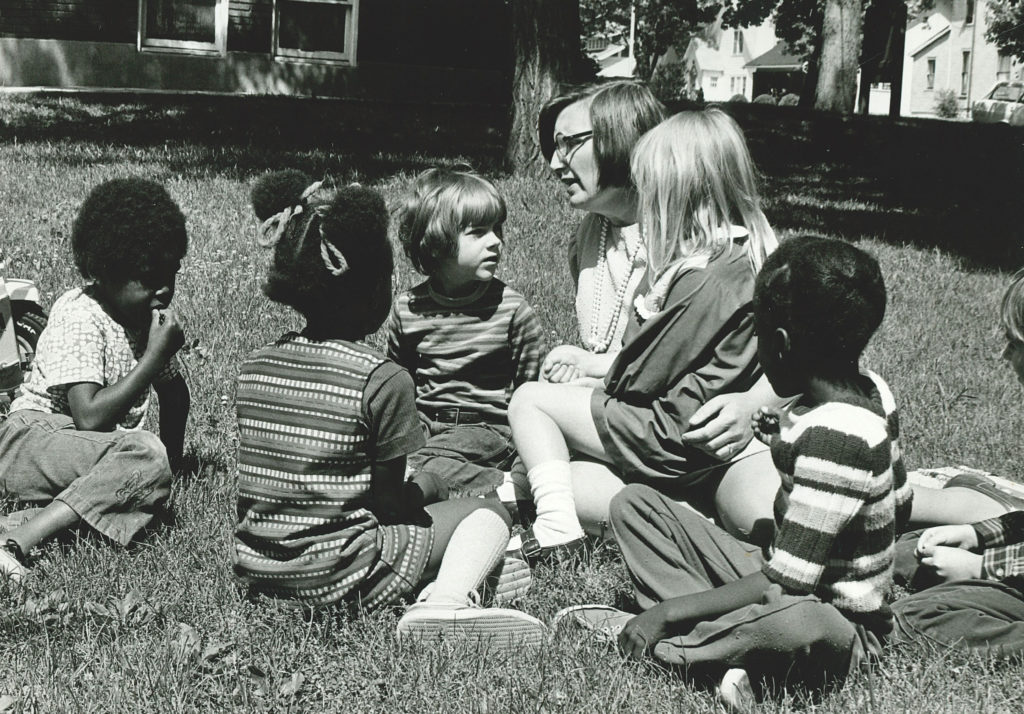
Fifty years ago, Chris Nicholson ’54 was among the leaders who established The Children’s School in 1971, which is now called Richmond Friends School and is a short walk from Earlham’s campus.

“Chris had a vision for an inclusive, student-centered school,” said Steve Cleaver, the head of school at Richmond Friends School, which began with seven students and Nicholson as the lone teacher. Warren and Nancy Smith joined Nicholson as co-founders.

“We have grown to serve nearly 90 students annually and remain committed to providing a quality educational experience for each child within a community that is explicitly framed by principles of the Religious Society of Friends,” Cleaver said. “After fifty years, you can still find Chris on campus and engaging with students during all-school meetings.”

Before growing into a preschool-to-eighth-grade school of choice in Richmond, the independent Quaker school leaned heavily on community resources to frame the school’s curriculum. Nicholson shared her story in a letter to the editor published by the Palladium-Item on Sept. 18, 2011.

“The neighborhood provided our social studies curriculum. We had a post office, fire station, supermarket, produce market, pharmacy, hardware store, all levels of educational institutions, several churches and a city park within walking distance,” Nicholson wrote. “We ‘sidewalk supervised’ the building of the north tower of Interfaith Housing and the destruction and construction required to build Doan and Mills Funeral Home. This inspired much counting, measuring, recording and writing.”

Families and fairness

Twenty-five years after Nicholson turned her vision into a school, Charlie Asher ’74 and his wife, Barb, established the Freedom 22 Foundation in Indianapolis to support initiatives in the fields of criminal justice, family law and K-8 education.
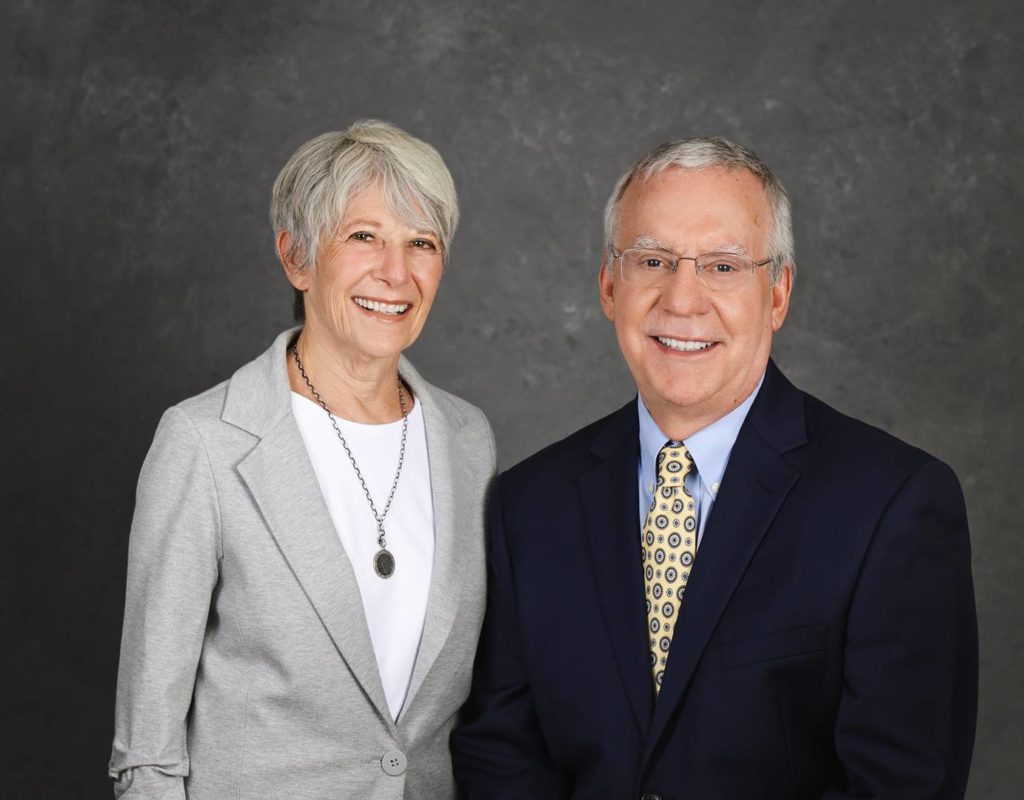
Barb and Charlie Asher

The Freedom 22 Foundation serves diverse needs, but its focus is on strengthening families in crisis and bringing more fairness to persons charged with or convicted of crimes.

Its initiatives include the websites uptoparents.org for separated and divorced parents to build family peace and defensemap.com for criminally charged persons to investigate and tell their backstories. Others, like the Earning Another Look program, offer help on sentence modifications to Indiana inmates demonstrating outstanding conduct and self-improvement while incarcerated. An upcoming documentary opposing the War on Drugs is also on the docket.

The Ashers have combined their respective backgrounds in criminal defense law and social work to push back against what they see as some enduringly unhelpful societal assumptions.

“Over time almost every profession seems to become beholden to sacred cows that ill-serve the public,” Charlie said.

“Lawyers are taught to see divorces and paternity cases as disputes, even though the parents’ best interests are overwhelmingly mutual,” he said. “We’re taught to judge people by the worst thing they’ve ever done, even though we’d never want such a judgment on us. We’re taught to think a War on Drugs that’s spiked American overdose deaths from 6,000 a year to over 100,000 a year is a sensible thing. And much more.”

Barb Asher cautioned that Freedom 22’s vision can sometimes outstrip its resources and capabilities.

“We have to be careful,” she said. “No charity, let alone a small family charity, can remake any profession.”

“But,” Charlie added, “it’s still surprising to notice some creative places where a focused response can make some difference.”

“And it sure gives you a reason to get up every day,” Barb said.
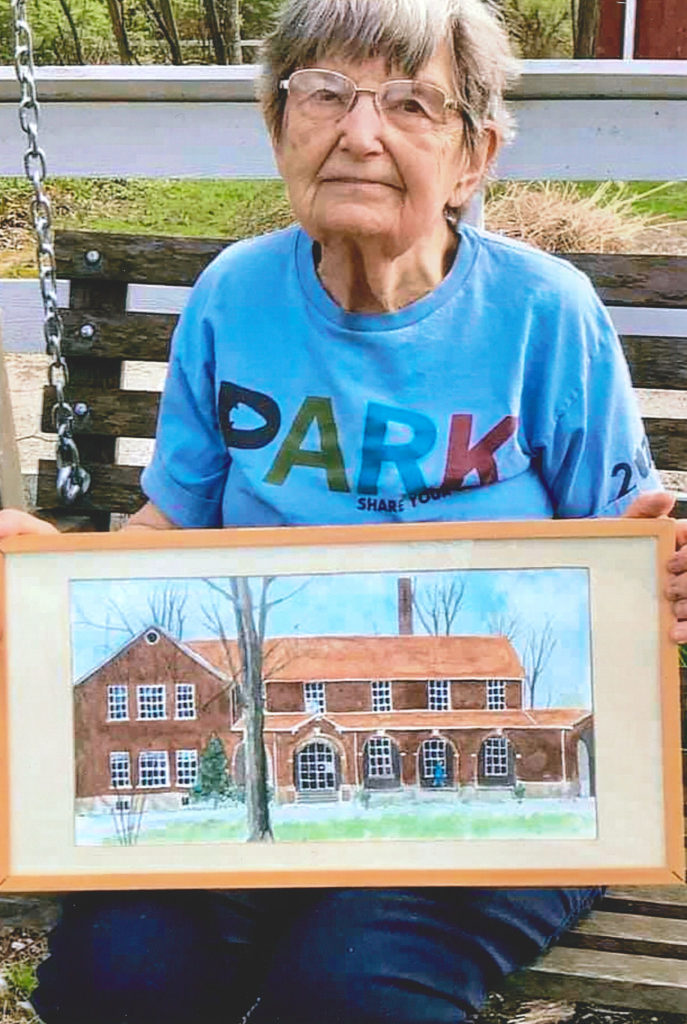
Chris Nicholson ’54 holds a painting of Richmond Friends School. 
Chris Nicholson ’54, center, sits with students at Richmond Friends School.

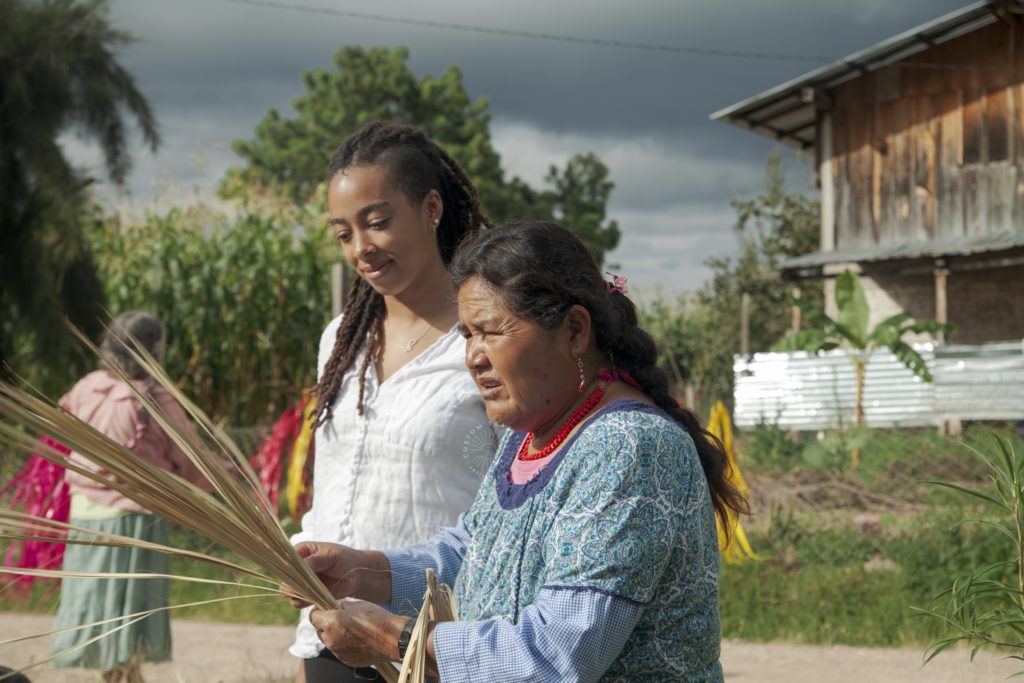
Chisama Ku Penn ’16 observes an artisan in the Mexican state of Oaxaca. (Photo: Natalie Reitz ’14)

Hand-crafted, with a worldwide reach

Like Crowe and her Empathy Bootcamp, Chisama Ku Penn’s ’16 founders’ story is just beginning. The recent graduate established Custom Tradition in 2019 to give indigenous artisans a platform to promote their work and share their products with a global audience. The organization was granted non-profit status last October.

Custom Tradition is partnering with one Mixtec community of indigenous women artisans whose livelihoods are at risk. Each woman has family members who have had to leave the country for the United States to find work. They have limited access to the internet and sell their handicrafts at in-person markets or from tourism sales. 

Penn lived with the collective in the Mexican state of Oaxaca for three weeks and documented the experience with help from her former photography teaching assistant, Natalie Reitz ’14. The collective is composed of women artisans who make baskets, hats and mats out of dried palm leaves using a traditional technique that is popular in Oaxaca.

“When the COVID pandemic happened, all of that went away,” Penn said. “Tourism decreased and the markets closed because that would require people to gather in large groups. They are limited right now to people like me who purchase their products and sell them online.

“I’m trying to help these women preserve their traditions and close that gap between them and the global market,” Penn said. “I want to make sure they have a sustainable option to make an income for themselves.

“I do that by working with them directly under a fair-trade model—paying them promptly and fairly and respecting their cultural traditions,” she said. “Getting to know them as people, allowing them to have autonomy over how they want to work and when they want to work.”

Penn is currently running a campaign on IFUNDWOMEN to further develop her vision for Custom Tradition and establish a grant program to help the collective expand their business operations and support healthcare needs, including vision care.
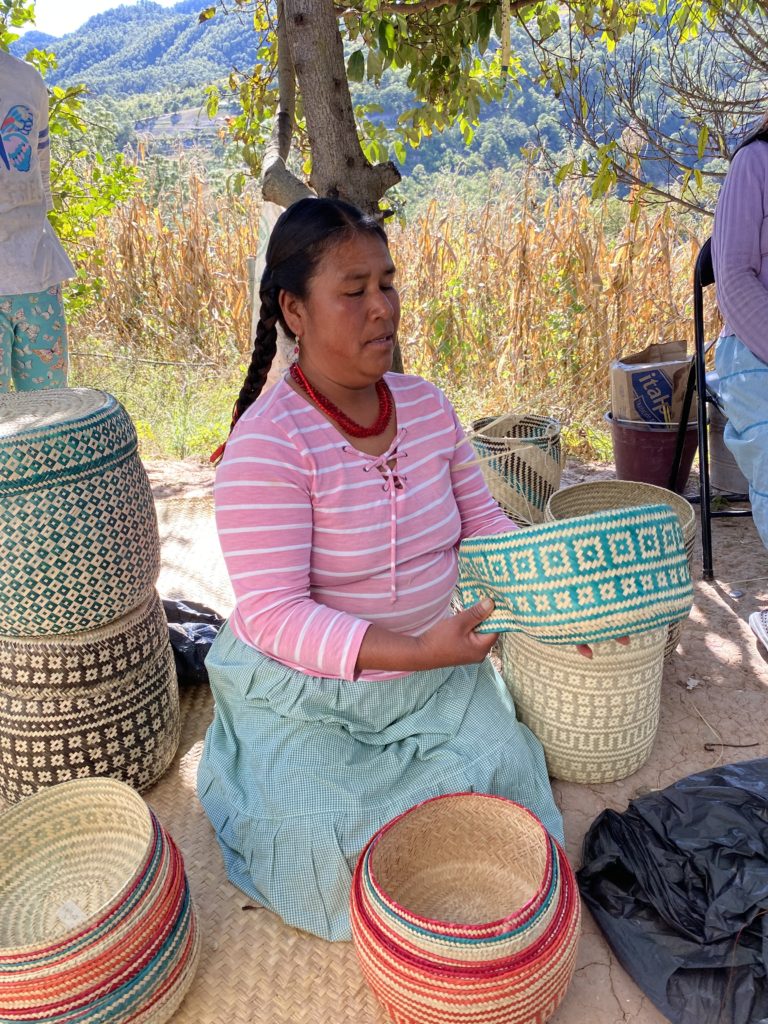
An artisan in the Mexican state of Oaxaca displays hand-made baskets that are popular in the region. (Photo: Natalie Reitz ’14)

Founders inspiring founders

Custom Tradition’s work is inspired by Bean Voyage, a project started by five Earlham students in 2014 that has grown into a thriving nonprofit social enterprise led by Abhinav Khanal ’16 and Sunghee Tark ’16. Bean Voyage describes themselves as a feminist nonprofit social enterprise on a mission to eradicate the gender gap in farming communities. 

“It was mostly students from my class,” Penn said. “I felt a sense of pride knowing that these people who were doing this amazing project had also come from Earlham and that they were people I would see or pass by daily on The Heart or in Saga. That is what inspired me; knowing that people from my community were doing something amazing, and because I was from the same community, I, too, had the potential to do great and impactful work.”

Penn said her Earlham education provided a spark for the rest. Originally planning to pursue a degree in international studies at Earlham, Penn pivoted to Spanish and Hispanic studies quickly after arriving on campus. A Bonner Scholar, the Atlanta native also volunteered with the local nonprofit Amigos during all four years of her undergraduate studies, allowing her to work with an organization serving the Hispanic community in Richmond.

“I just really loved the Spanish department at the time,” Penn recalls. “The professors were really great people, and I was drawn to them as people and teachers. I wanted to understand the Spanish language from the inside out—the culture, the linguistic aspect of it, the literary aspect of it.”

During her senior year, Penn was awarded a Fulbright to become an English-language teaching assistant in Argentina, an achievement that further propelled her professional aspirations by igniting curiosity over the country’s experience with immigration.

“Argentina is very European and heavily influenced by immigration from Spain, Italy and Germany,” she said. “When you talk to people, there is a sense that indigenous people don’t live in the country anymore and that they have been erased from modern culture. In my travels to different parts of the country, I talked with ancestors of native peoples and found that to not be true.”

After completing her Fulbright, Penn continued traveling and spent two years working various non-profit and community organizations. She also began thinking more about how she could continue to be involved in work related to her degree while still making an impact on the lives of the people she worked with. 

“At the time, I was looking for ways to continue my education in Spanish—I didn’t want it to end with Earlham,” she said. “I was tired of working for people or organizations I couldn’t connect with.

“With Custom Tradition, I’m still of service to someone, but I’m continuing to learn and improve and bridging gaps between cultures and communities. All of my experiences at Earlham, as a Bonner Scholar, a Fulbright Scholar, have led me to this.”

“With Custom Tradition, I’m still of service to someone, but I’m continuing to learn and improve and bridging gaps between cultures and communities. All of my experiences at Earlham, as a Bonner Scholar, a Fulbright Scholar, have led me to this.”

Chisama Ku Penn

Story by Brian Zimmerman. Photos supplied. Photos in Oaxaca by Natalie Reitz ’14 (www.nataliejreitz.com).

Like what you’ve read? Share this article with your network.

ADDITIONAL STORIES
Throw a challenge her way and Liv Kyrk ’24 MAT ’25 will face it head on. Kyrk recently completed her Read more
Coming back to Earlham has allowed Alisa Damholt '04 to reconnect with Dance Alloy, the student-run organization that originally fostered Read more
As Earlham historian and Quaker scholar-in-residence Tom Hamm writes in his book Earlham College: A History, 1847-1997, Earlham’s first formal Read more
Earlham College has earned a trio of new certifications that strengthen its commitment to environmental sustainability and reflect its dedication Read more
Earlham alums work to make the world a better place — beginning at home. Read more
Tom Rockwell M.Div. ’24 and Jade Souza M.Div. ’25 met at the Earlham School of Religion as students. The couple Read more
The Earlham College varsity baseball and softball programs began the 2024-25 academic year with a new indoor practice and training Read more
Makayla “Mak” Hurey ’25 has redefined resilience and excellence for Earlham’s women’s soccer team, breaking records while anchoring a program Read more
Hashem Abushama ’17 was named an Associate Professor in Human Geography at the University of Oxford and is serving as Read more
In August 2024, Paul Sniegowski arrived at Earlham College as its 21st president, bringing three decades of experience as a Read more
Susan Hillman de Castaneda
In offices scattered across Earlham’s campus, staff members work on the often-unseen aspects of keeping a college moving. They recruit Read more
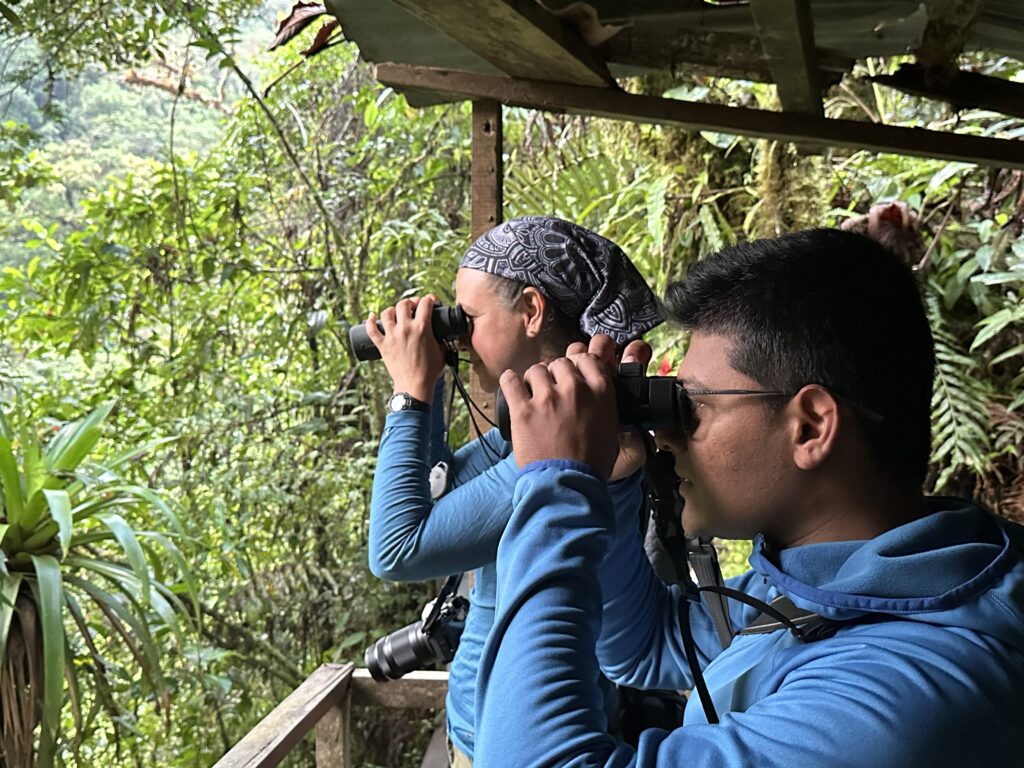
Kasun Bodawatta (right), a young adult male, watches birds through binoculars with Wendy Tori (left). Bodawatta wears a blue sweatshirt and sports wire rimmed glasses and a short black haircut. Wendy also is wearing blue and has her hair pulled back in a ponytail with a grey headband.
KASUN BODAWATTA ’15 came to Earlham pretty sure that he would major in geology. That changed when he happened to Read more
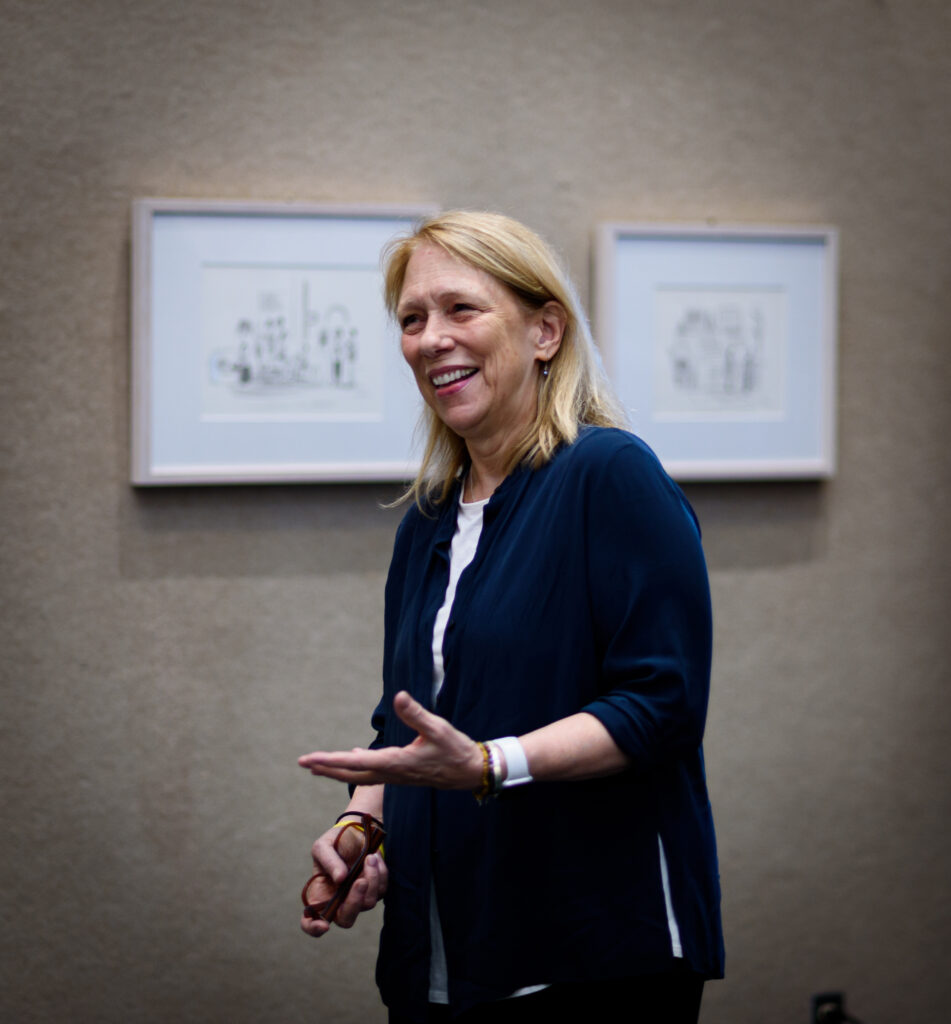
Liza Donnelly at her recent artist talk for Homecoming Weekend 2024. Liza sports blonde hair and a navy blue cardigan and stands in front of displays of her cartoons that she's drawn across the decades.
When Liza Donnelly ‘77 was a young girl, she found socializing difficult. “I was painfully shy, growing up,” she said. Read more
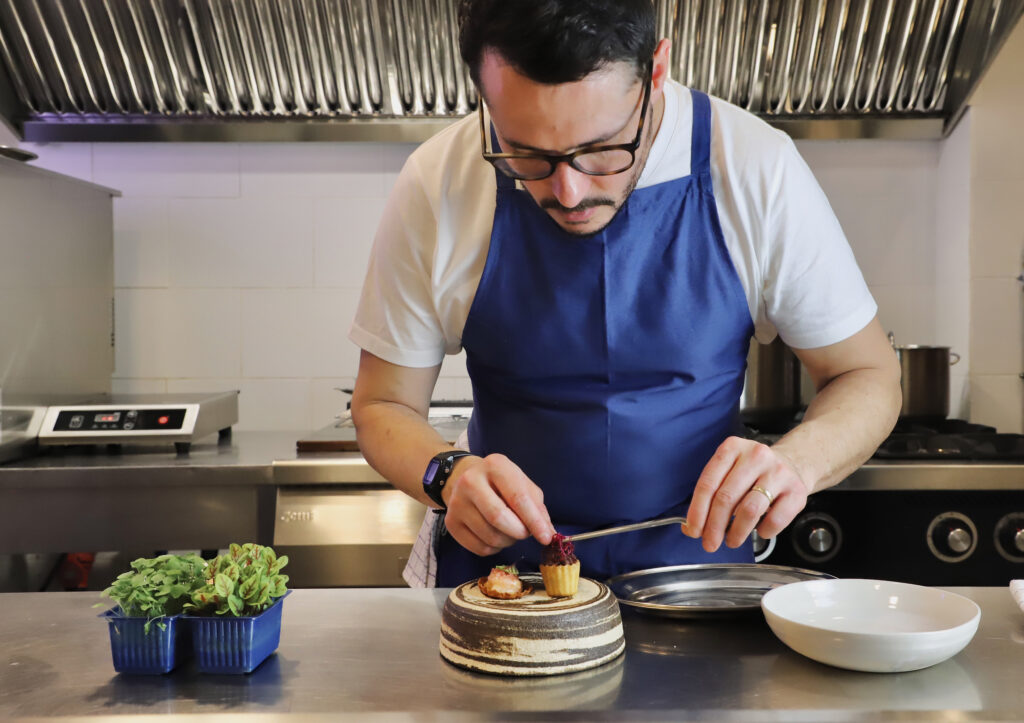
Pachi in the kitchen
Earning an Earlham degree in chemistry may be at the heart of Chef Pachi Rodriguez’s nod from Michelin for his Read more
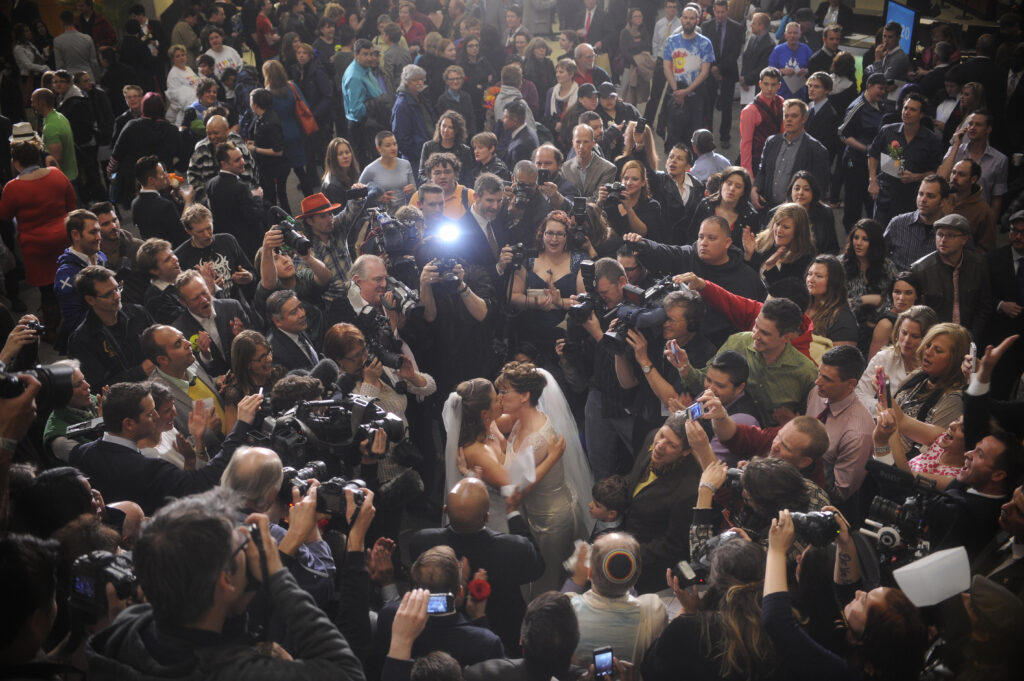
Anna Sher Simon ’91 likes to joke that her living room is a shrine to marriage, and a visit to Read more
April 18, 2025

Earlham’s volleyball star Liv Kyrk has served the ball and has also served up mentorship.

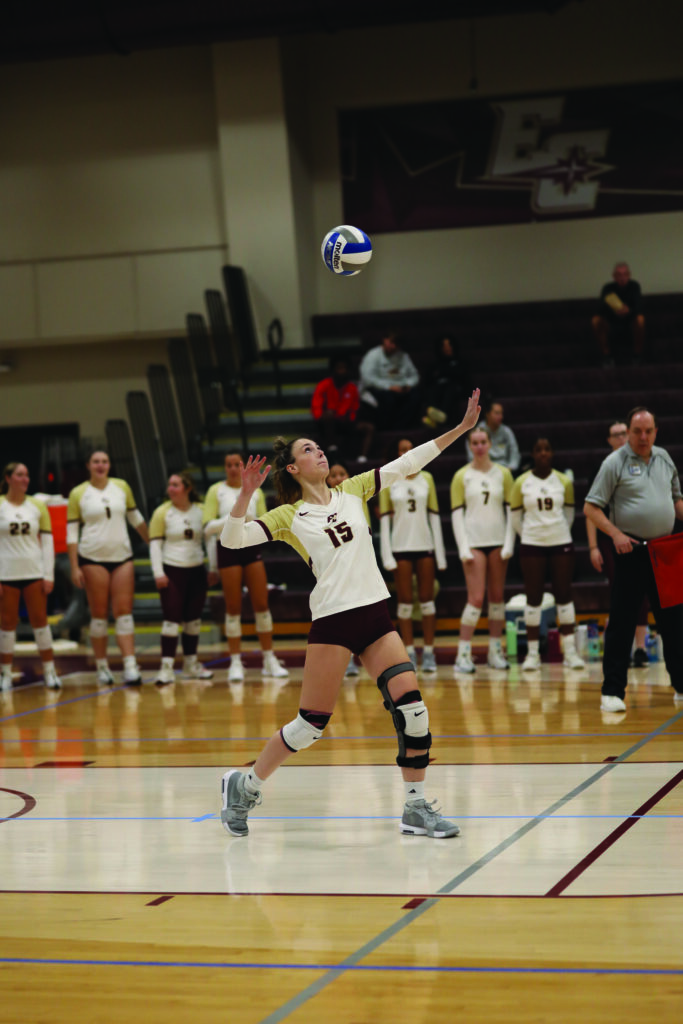
Liv Kyrk practices serving before the Heartland Collegiate Athletics Conference pre-season tournament opener against Mount St. Joseph University

Throw a challenge her way and Liv Kyrk ’24 MAT ’25 will face it head on. Kyrk recently completed her fifth year as a member of the women’s volleyball team, earning an extra year of eligibility due to Covid and coming back from a season-ending knee injury suffered during her senior year.

Kyrk, who is completing a one-year master’s program for art museum education, was immersed in academics and extracurriculars while being a dual-sport athlete, fully embodying the ethos of Quaker campus life. She had the blessing of both according to Head Coach Lauren Horton.

“I try to align myself with the Earlham values of really submerging yourself into the culture of the campus and being able to do all of the things,” Horton tells her players. “I don’t want you to be a volleyball robot.”

Kyrk was no robot, but she did produce on the court. In her three complete seasons as a starter, Kyrk was top 10 in the conference in hitting percentage, hitting .281. She posted 723 kills to just 255 errors and placed top two on the team in blocks in each of her healthy seasons. She was also a member of the Earlham track team for three seasons.

“Earlham grows on you,” says Kyrk, who majored in painting. “I got to know everyone, and we became a family.”

After a condensed freshman volleyball season during the pandemic, where the team played a short series of doubleheaders against conference opponents, Kyrk was ready for a full and productive season. Her sophomore and junior years she was named to the Heartland Collegiate Athletics Conference all-tournament team, and first team All-HCAC, respectively. Then, just five games into her senior year, Kyrk tore her ACL, which led to season-ending surgery.

Despite the injury, Kyrk continued to attend every practice, game and team meeting that season. “She did her absolute best to stay engaged,” says Horton. “She was helping in drills. It never derailed her and didn’t take her out of the gym.”

Entering the 2024 season, as a fifth-year veteran, Kyrk’s role morphed as she battled back from injury and began mentoring several incoming players, who lovingly refer to her as “Meemaw” — a name sometimes used for grandmothers. Using a cane during recovery completed the portrait of an experienced collegiate athlete.

“I couldn’t do the things you need to do for volleyball, so I spent the first half of the season trying to remember how to play,” says Kyrk. “It’s just really difficult to be bad at something.”

Kyrk missed the first 10 games of the season rehabbing her knee, only to come back stronger than ever. The Quakers made it all the way to the HCAC semifinals, after being ranked sixth in preseason polls.

“It was so fun having that extra year and having the chance to do it again,” says Kyrk, who led the team to the postseason for five consecutive years. “I viewed it as a bonus season.”

Kyrk is looking forward to graduation this spring and endeavoring on her post-collegiate life, which may include coaching.

“I know so much about volleyball because I’ve spent my whole life playing,” said Kyrk. “It would be nice to help other people find that love of the sport.” ■

Story by Aubrey Everett / Photos by Josh Smith

Dance Alloy alum expanding student organization’s footprint

From left: O’Jeanique Twyman, Luz Miriam Tafradjiyski and Ali Damholt at the Dance Alloy Throwdown event in Fall 2024

Alisa Damholt’s ’04 path to becoming an Earlhamite was unique.

“Earlham took quite a chance on me,” she said. “They accepted me without a GED or diploma. I came to college when I was 17, and it changed my life.”

Damholt has since earned her master’s degree and built a successful career as a social worker and leader.

When she recently opened her job search looking for director positions, she found her alma mater hiring the director of counseling services for the first time in 20 years. “I thought this would be a great opportunity to be in service to a school that I loved and was so formative for me,” she said.

Coming back to Earlham also allowed Damholt to reconnect with Dance Alloy, the student-run organization that originally fostered her love of dance.

“Dance Alloy introduced me to dance. I was not a kid who grew up taking dance. I also did not have a typical dancer physique,” she said. “Coming to Earlham, I wasn’t rejected because of my body type or because I moved in a different way.”

And she followed that passion throughout her career, working as both a dancer and choreographer for dance companies. “Dance Alloy lit a fire, a passion for dance, that turned into something professional and wonderful for me,” she said.

With organization and preservation of history as her primary goal, Damholt created a digital archive and extensive handbook using information and items gathered from the college archives and former members and supporters of Dance Alloy. Now in its 35th year as an organization, Damholt wanted all current and future members of Dance Alloy to know their history and have the foundation necessary to successfully run performances. The handbook also allowed Dance Alloy to build on their processes, and they introduced several Google forms to track metrics of dancers and increase communication with participants.

Upon her return to Earlham, Damholt met with the students of Dance Alloy and pitched herself as a supportive faculty member. Damholt filled the advisor role when there was a vacancy, and promised to help Dance Alloy complete necessary “fundamental shifts,” and find new ways to increase membership so the organization can grow. Hancock Room in Runyan Center, the official practice space for Dance Alloy, was completely reconceptualized, with photographs, articles and other visual mediums representing the past, present and future of the organization displayed. A dedicated costume closet was added as well.

“Having a physical space tells these students that what they do is important,” Damholt explained. “Their work should be as visual as a student athlete’s.” Damholt also worked to update shows for a modern audience and dancers.

She started offering “cleaning services” to choreographers interested in utilizing this new option, lending a final eye on their dances with focus on creative details like blocking and angles. She also worked with Dance Alloy to bring the organization’s first ever “sensory friendly” show to campus this past fall. This edition was born out of a desire to increase accessibility for students, faculty and community members.

To make this matinee show sensory friendly, house lights were kept at half and on the entire show, sound decibels were reduced by a third and all types of self-soothing behaviors were encouraged.

“There were no stipulations on the audience. We didn’t say they couldn’t clap or yell. But we wanted it to be less intense so we could see if we could meet a need,” she said.

For Karissa Hauke ’26, co-convener of Dance Alloy, these changes have all been welcomed.

“Ali loves Dance Alloy, and I can see that by the way she uses her time and offers us guidance,” she said. “I really love to see her involvement. She is so willing to communicate and talk with us and have us involved in all decisions.”

Both Hauke and Damholt came to Dance Alloy with no previous dance experience. And for Damholt, that is what makes this organization so special and unique.

“Dance Alloy says come as you are and create,” she said. ■

Story by Kelsey Mackey/Photos by Tsitsi Makufa and Kate Young

75 years of international education reporting

As Earlham historian and Quaker scholar-in-residence Tom Hamm writes in his book Earlham College: A History, 1847-1997, Earlham’s first formal study abroad program began in 1956 with French professor Mary Lane Charles. She was supported by trustee Dorothy Peaslee with funding, and took 15 students to France. They began with studying languages in Geneva, Switzerland, before landing in Paris. All lived with French families during this time. In the next four years, Charles would take two more groups to France. Faculty also led trips to Italy, Mexico and Scandinavia, with plans for additional trips to Russia and Japan. Once former President Landrum Bolling began his administration in 1958, the study abroad program blossomed, and is now a viable part of academic departments and other parts of the college experience.

Earlham’s rich legacy in international education programs was preceded by the enrollment of Canadian Quaker Edwin H. Dorland in the 1860s and Chuzo Kaifu, a Japanese student from the Friends Tokyo School, in 1890, who became the first international students to enroll at Earlham.

“Of course, that was the beginning of our connection to Japan,” said Hamm, “which has remained strong down to the present day.”

Over the years, Earlham has been honored to host a variety of international students, from Japanese students in 1890 and again in the 1930s and ‘40s, to German students before Kristallnacht and reverberations of World War II, to more recently, Palestinian, Syrian and Israeli students.

For each program Earlham offers and each international student who enrolls, the college reports to the Institute of International Education’s Open Doors program. The institute recently recognized Earlham with the Seal of Excellence for having contributed reporting for 75 consecutive years.

Earlham students abroad in Jordan, 2012

That seal of excellence from Open Doors “shows that we are the gold standard in our field,” said Roger Adkins, executive director of Earlham’s Center for Global Education. “The 75-year recognition demonstrates a longstanding commitment across many generations of leadership and staff,” they said. “Most schools have a study abroad program and do this reporting, but not many have done it for 75 years running.”

Today, Earlham offers dozens of study abroad programs all over the world in locations such as New Zealand, northern India, Iceland, Ghana, Turkey, Scotland and Japan. International students now number 143, a far cry from the 12 enrolled 75 years ago.

Jennifer Lewis, Earlham’s senior director of off-campus programs, completes the international study abroad report, which includes off-campus study, credit-bearing international programs, credit-bearing internships and non-credit-bearing international activities. It’s both these reports and incoming international student and scholar reports that the recognition and Seal of Excellence honors.

“It’s important to note that this 75-year history of Earlham’s coincides with the entire time Open Doors has been active,” said Adkins.

Founded in 1919, the Institute of International Education conducts an annual census of international students in the U.S. For the first 30 years, IIE and the Committee on Friendly Relations Among Foreign Students carried out this effort jointly. IIE’s first independent publication of the results of the annual census reported on data for the 1948-49 academic year. That publication was renamed the Open Doors Report on International Educational Exchange in 1954-55, and since then, Open Doors has had a long history as the comprehensive information resource on international students and scholars in the U.S. and on U.S. students studying abroad.

Since that rebrand, Earlham has been right there collecting data and has always participated.

“This is a report that every program does, so for us to be recognized for excellence for more than seven decades, it demonstrates our commitment to global education across the board,” said Lewis. “This is something that Earlham pays lip service to, but it demonstrates quantitatively our values and commitment.” ■

April 17, 2025

Earlham College earns multiple environmental sustainability certifications

Earlham College has earned a trio of new certifications that strengthen its commitment to environmental sustainability and reflect its dedication to hands-on learning and ecological stewardship.

By demonstrating leadership in fostering biodiversity and promoting sustainable practices on campus, the college has become Bee Campus USA certified by Bee City USA as well as earned Growing Home Certification through the Red-Tail Land Conservancy. Miller Farm has also been certified organic by the USDA.

“These are all things that further the environmental goals of Earlham,” said Jaime Coon, assistant professor of biology and environmental sustainability. “Certifications can do different things. They recognize the good work we’re already doing and hold us accountable to continue doing that work in the future. It’s also a great opportunity to market the College and showcase our values.”

Bee certification underscores Earlham’s efforts to create pollinator-friendly habitats. Initiatives such as the showcase pollinator garden, pollinator parks and native prairie restorations have contributed to this recognition.

The Growing Home Certification celebrates Earlham’s transformation of multiple outdoor spaces into wildlife-friendly habitats. From tallgrass prairies to rain gardens, students and faculty have collaborated to restore biodiversity.

“Having a native forest and adjacent prairies on campus is a rare resource,” said Melanie Kazenel, visiting assistant professor of quantitative plant ecology. “These certifications spread the word about the unique and precious wildlife habitats we’re cultivating.”

Miller Farm’s USDA Organic Certification, awarded through the Ohio Ecological Food and Farm Association, marks a significant milestone. The farm, managed by Lucy Enge, also received the Real Organic Project’s add-on certification, ensuring the integrity of soil-grown and pasture-raised products under USDA organic.

“This certification is about accountability and outward-facing ideals,” Enge said.

“Today’s generation understands what certified organic means, and it’s an exciting opportunity for prospective and current students to see a certified organic farm in action. It’s a lot of paperwork and inspections, but it connects us to a larger network of certified farms.”

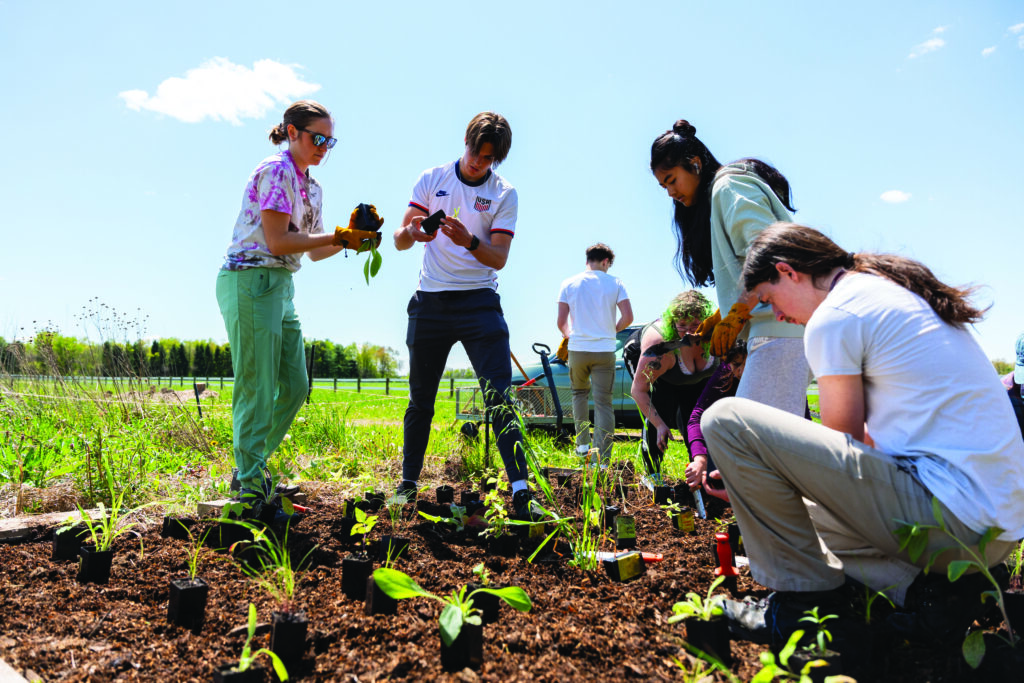
Students play a critical role in achieving and maintaining these certifications. From growing native plants to conducting ecological restoration projects, their involvement is essential.

“Students appreciate seeing their efforts come to life,” Jamey Pavey, director of Earlham’s Center for Environmental Leadership, said. “Planting seeds for the prairies early in the semester and watching their ‘plant babies’ thrive is a rewarding experience.”

Earlham’s commitment to sustainability aligns with its Quaker values. “Being certified organic feels like a reflection of who we are,” Enge said. “We’re not just Quaker on paper; we’re Quaker in practice.”

These certifications represent more than achievements — they symbolize Earlham’s dedication to environmental leadership, providing students with opportunities to gain practical skills and engage with the land.

As Coon noted, “this is all about getting students out to learn practical skills and have fun. It’s career discernment, ecological restoration and hands-on learning all in one.” ■

Hometown Love

Earlham alums work to make the world a better place — beginning at home.

Taking Out the Trash: Eric Twumasi ’25

Eric Ford Twumasi ’25 first walked onto the Earlham campus dreaming of a career in business, finance or leadership in the non-profit world.

But always in the back of his mind was the plight of his homeland of Ghana, where trash and pollution have threatened the health of residents of the West African nation. Before embarking on any career, he was determined to do what he could to affect change there.

Today that dream has become a reality.

Twumasi, an Earlham College senior with a double major in business and mathematics, has used a $10,000 Davis Projects for Peace grant to create a system in his home country to combat contamination and disease, employ and educate residents in the fight against pollution and, ultimately, foster a sense of community.

The project is called the “Kama Campaign,” kama meaning clean in Akan, one of the predominant languages in Ghana.

“We launched the project in May and are now working to make it sustainable,” he said. “We’re starting on a small scale but hopefully someday can make it something to give to our nation.”

Kama Campaign workers have placed industrial-sized trash bins on the streets around his home community of Ayigya Zongo, a poor suburb of the city of Kumasi.

Paid residents empty the bins, taking the trash and refuse to a recycling center, about two hours away.

Workers, especially young people, were hired to walk the streets and inform residents about the collection bins, about recycling and the importance of proper disposal of refuse.

“This project is about much more than waste collection,” Twumasi said. “It is about empowerment and sustainability.”

Twumasi grew up in the Ayigya Zongo neighborhood and witnessed first-hand the health and environmental crisis facing his community.

The smell of sewage filled the air. Trash choked the streets and river banks. Residents dumped refuse in public drains, in violation of government regulations, causing flooding and added health risks. Cholera, diarrheal disease and typhoid fever were rampant. A 2021 study by the Kwame Nkrumah University of Science and Technology identified his region as a “hot spot” for cholera.

“When I was in high school I saw the extent of the problem,” Twumasi said. “People were dying from cholera. What I witnessed spoke to me. I asked myself what can I do to help with this.”

At Earlham, Twumasi wrote his plan, which included partnering with the environmental education advocacy group, Terraplus Ghana, and with the Kumasi Compost and Receiving Plant, the largest such plant in Africa.

The campaign has taken off, especially the educational component.

“It was like a political campaign, we had people going street by street,” Twumasi said. “And the result has been very positive. People have been receptive. Already we’ve noticed a significant change. The area is much, much cleaner.”

Twumasi hired students from the science and technology’s visual arts department to design the 100 industrial -sized waste bins purchased for the project. He also bought two motorized tricycles for hauling waste to the recycling plant.

He has met with the region’s municipal authority and a member of the country’s parliament to gain their approval.

“They thought it was a great idea. There is definitely interest in this project,” he said.

The campaign also included a “Kama Club” to bring residents together to learn about recycling, proper sanitation and community. Already 76 people have signed up.

“It has appealed to young people, especially young mothers. They have been very receptive. It is actually working just the way I hoped it would and I am so pleased,” Twumasi said. “People are working to clean up our neighborhoods and getting paid for it. They are working and earning an income and the results have been obvious.”

Bins are being filled and then emptied, streets and riverbanks are showing less trash. And education is continuing.

Twumasi learned of the grant possibility in his honors program at Earlham. He watched as Earlham junior Ted Jacquet ’23 received the Projects for Peace grant in 2021 for a project in Haiti and another classmate, Wisdom Boinde ’23, received the grant the following year for a project in Ghana.

“Ted and Wisdom guided me, which was a big help. I learned so much from them,” Twumasi said.

Jacquet was also president of Net Impact at Earlham, a club focused on helping students become entrepreneurs and create non-profits that inspire climate action and sustainability.

“Being involved in Net Impact reminded me of what I had experienced in my home,” Twumasi said. “As much as I wanted to go into a chosen field I also wanted to have a non-profit which would allow me to give back to my country.”

Nate Eastman, Earlham professor of English and director of the honors program, met Twumasi in his first-year honors seminar. Eastman said Kama Campaign fit nicely into the program’s values of motivation, excellence, leadership and humanity.

“Eric’s project kind of checks all those boxes,” Eastman said. “What I saw in Eric was a strict attention to finding ways of addressing these real world, complex problems.”

Eastman nominated Twumasi’s Kama Campaign for the National Collegiate Honors Council’s Engagement Award, which allowed Twumasi to present at the NCHC’s annual conference.

“That was a great experience for him,” Eastman said. “Big ideas don’t always solve complex problems. Instead it takes hard work to handle a lot of moving parts and details and Eric is really, really good at that.”

In a short period of time, the Kama Campaign has laid a foundation for waste management and community development.

“One of the things we focus on is developing programs that help our fellow human beings,” Eastman said. “Eric’s project really spoke to the values of our honors program.”

So, as the work continues in the streets, Twumasi is looking ahead to possible expansion.

“Right now I’ve begun looking for investors to help move the project forward,” he said. “I am so thrilled because while we are advocating for the environment we are also advocating for the people.”

Community Convener: Dakota Collins ’15

When Dakota Collins ’15 was a sophomore at Richmond High School a friend “dragged” him to a student council meeting. It was a modest start to what became a way of life. That meeting lit a spark in Collins that inspired him to be involved and to lead, first in student government, then city government, in local politics, in community activities and economic development efforts.

His path was never easy but was made easier by friends, family, mentors and community leaders who welcomed him, encouraged him, supported him.

When he graduated high school, Earlham became the perfect fit for him. “I was one of those activist students and I knew Earlham was a great place for activist students,” Collins said.

When he graduated, he committed to working in his hometown, to lend his dedication and passion to the effort to steer his community toward future success. Today, Collins is director of community relations at Earham and is leading an effort that could reshape and rebuild the city’s business district for years to come.

The effort is called Revitalize Richmond and is being fueled by a five-year, $25 million grant that the College secured from Lilly Endowment Inc. in 2024. The funds will help local leaders rebuild the downtown business district, support entrepreneurs, save endangered historic buildings and, most importantly, connect the Earlham community to Richmond’s central city.

“Earlham has waxed and waned with community relations for decades,” Collins said. “Ever since the Vietnam War there has been this town-gown divide and over the last 50 years it has gotten better and it has gotten worse. This is an opportunity for Earlham to be a community leader again and continue that role beyond the five-year life of the grant,” he said.

Collins studied business, politics and psychology at Earlham and, after graduation, worked in local politics and business before being hired at Earlham as director of annual giving. He relished his role as one who raised money to bring new students to campus.

“It was the same group of feelings that brought me to Earlham in the first place; this desire to give back to the college and to give back to another generation of Earlhamites,” Collins said.

While working in fund-raising for five years, Collins noticed that no one’s full-time role at the college was focused on community relations. He volunteered to take that job on part time, renewing his commitment to Earlham as being an important part of the community’s development. When the college received the Lilly grant, Collins took on the task of handling the grant full-time.

“I can’t take credit for bringing the grant here,” he said. “We have a fantastic grants team that helped me throughout the process and wrote the actual proposal and did so much of the work. My role was more to bring in the community and help decide where the money would do the most good.”

Still, acclaim has followed his efforts to make the grant a reality.

“Dakota is a tremendous example of how a local Earlham College graduate can really make a difference in our community,” said Valerie Shaffer, the president of the Economic Development Corporation of Wayne County, one of the key players in the project along with Richmond city and Wayne County governments, Reid Health, private investors, local foundations and non-profits.

“He has taken ownership of this project in a way that has shown his passion for this community,” Shaffer said. “He has grown into such a strong leader, not only for this project but in the community as a whole.”

“Dakota has been a huge asset for us,” added Beth Fields, the City of Richmond’s director of Strategic Initiatives. “He has served as convener of this group and has played an important role in making sure we have a broad range of voices around the table. For this project to succeed it was hugely important for us to have people involved and contributing.”

His commitment comes, he said, from his love of the Richmond community and the people who have supported him, taught him and helped him grow.

“This is my home,” he said. “I’ve thought about doing something else but I don’t think I would have the passion to go somewhere else and do the things I’m doing here. I love and care about this community. It has supported me in ways for which I will forever be in its debt.”

As an undergrad at Earlham, Collins took to heart one of Earlham’s underlying themes: think globally and act locally.

“That’s what makes Earlham really, really special,” Collins said. “My experience there was unique. Bringing in people from 75 different nations and all of these different backgrounds gives you incredible perspective on the world. The other piece for me was how do you take that perspective you’ve been given, that broader view, and use it to help the people and systems that are closest you. That’s what it’s always meant to me. It’s who I am now.”

What drew Collins to Earlham was “that system of shared governance from the administration to the faculty and then, for me, to the students,” he said. “Student participation in governance of the institution made this place seem important and weighty, significant and appealing.”

The Lilly grant was built to foster cooperation between the school and the community at large. Revitalize Richmond will result in the development of new urban housing in downtown, improved transit connecting Earlham’s campus to downtown, new outdoor recreation opportunities in the Whitewater Valley Gorge and other quality-of-place improvements to help Earlham and Richmond grow together.

The $25 million was available but only to serve as 30 percent of the funding. The rest, or $56 million, had to be “found” locally.

Fortunately, several downtown housing projects provided much of the balance of dollars needed to secure the grant. A total of $83 million in local matches from local leaders will result in more than $100 million in investments across the city.

Collins sees the grant as a “launching pad” for the continued development of the downtown and Earlham’s connection to the city.

“It’s not just about the five years of the grant and getting as much done as we can,” he said. “It’s to get us started and lay the foundation so that other people can take up the mantel and do more.

“We want to see the revitalization continue for years to come and we at Earlham want to be a part of that,” he said.

Finding God in every person

Tom and Jade Rockwell in their home

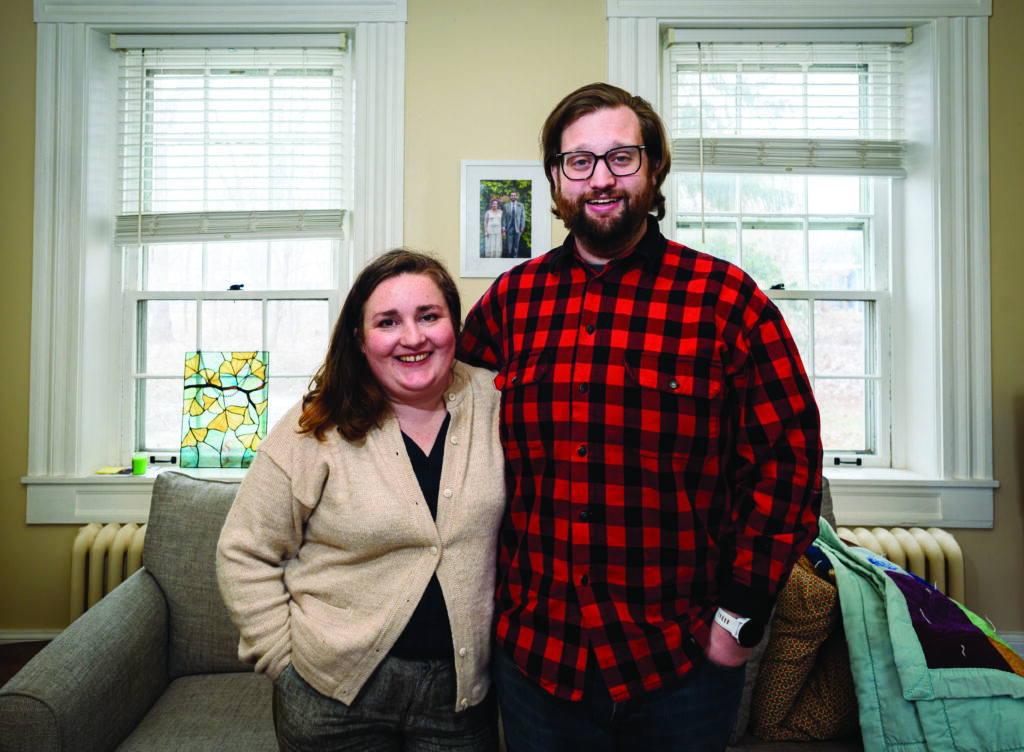
Tom Rockwell M.Div. ’24 and Jade Souza M.Div. ’25 met at the Earlham School of Religion as students with a shared goal of revitalizing Quakerism for younger generations and living out their faith. While Jade finishes her degree, she works for the Friends World Committee for Consultation. Tom has already completed his degree and works at Western Yearly Meeting in Indianapolis. The couple is putting their faith in action by helping Cubans during the ongoing refugee crisis by relocating to the U.S.

But none of that work could begin until they met.

“Our professor, Phil Baisley, who was the professor of pastoral ministry at the time, still likes to take credit that he introduced us,” says Jade. The couple took their first seminary class together, then the rest was history.

Important to them both is putting their faith in action. So when the opportunity came about to sponsor Cuban refugees to come to the U.S., they jumped on it. It dovetailed perfectly with Jade’s previous work in Cuba.

The start of the process was getting training for the humanitarian parole program through the United States Citizenship and Immigration Services. “We set up a sponsor circle, which was myself, Jade, my dad and two local Quakers who applied to be legal sponsors of the Cubans who were coming,” says Tom. The process also includes government paperwork, both on the U.S. side and the Cuban side. After that: nail-biting anxiety and tons of waiting.

With travel arrangements finalized, the group prepared for their stay at the couple’s new property, the former home of Earlham professor and Quaker historian Hugh Barbour. Things were happening. “We had three people come,” says Tom. “We housed one of them and then a local Quaker rented a room to the other two.”

The work wasn’t done, though. The refugees were in the U.S. but they needed to become familiar with the country and the refugee and welfare paperwork that entailed.

Exhausting, yes. But done with love and spiritual truth in mind.

“The seminary is a Christian Quaker seminary, and our life is one expansion of what that might look like in practice,” says Jade. “There’s lots of other ways that looks, too. Part of the nature of Friends theology is that individuals need to discern for themselves what is true and try to follow God in a way that feels truthful to who they are and to their own conscience. For every one version of that, there are lots of others. The way Quakers talk about their testimony, it’s like our lives are our testimony. And if what we say doesn’t line up with how we’re living, then what we’re saying isn’t really true.”

For Tom and Jade, that means putting themselves out there and embracing a theology of love, liberation, hope and revitalization — revitalization of Quakerism for younger generations, and liberation, hope and love for refugees and immigrants. “All of the work we do is interconnected,” says Jade.

“I think we’re primarily interested in the revitalization of the Religious Society of Friends and I think the refugee work fits in because there’s an inherent theological focus in Quakerism on our interconnection across the world,” says Tom. While the Rockwells have a particularly close tie to Cuban Friends, they also have ties in Richmond, in Kenya, in Latin America. Interconnection and the love found through that are crucial for them.

“The central focus is that there’s God in every person, and we should value each person in the way that God sees them,” says Tom. “In a time when it’s increasingly difficult to value your neighbor and their point of view, there’s a basis that’s founded on the idea of essential value of all people and taking everybody seriously, and trying to find ways to connect and love them seems like a very timely message.”

Gretchen Castle ’79, dean of the Earlham School of Religion, sees the couples’ work as timely and exceptional.

“They contribute to the betterment of the world in so many ways,” she says. “They each serve in Quaker positions that are inhabiting the ways Quakerism is changing. They build meeting engagement, encourage young adult leadership, and bring people together for collaboration. Together they pastor a local Quaker church, and they have been instrumental in supporting the growth of the Hispanic community in Richmond. May their leadership and ministry flourish as Quakers forge new ways forward in these changing times.” ■

April 16, 2025

Indoor training facility debuts for baseball, softball

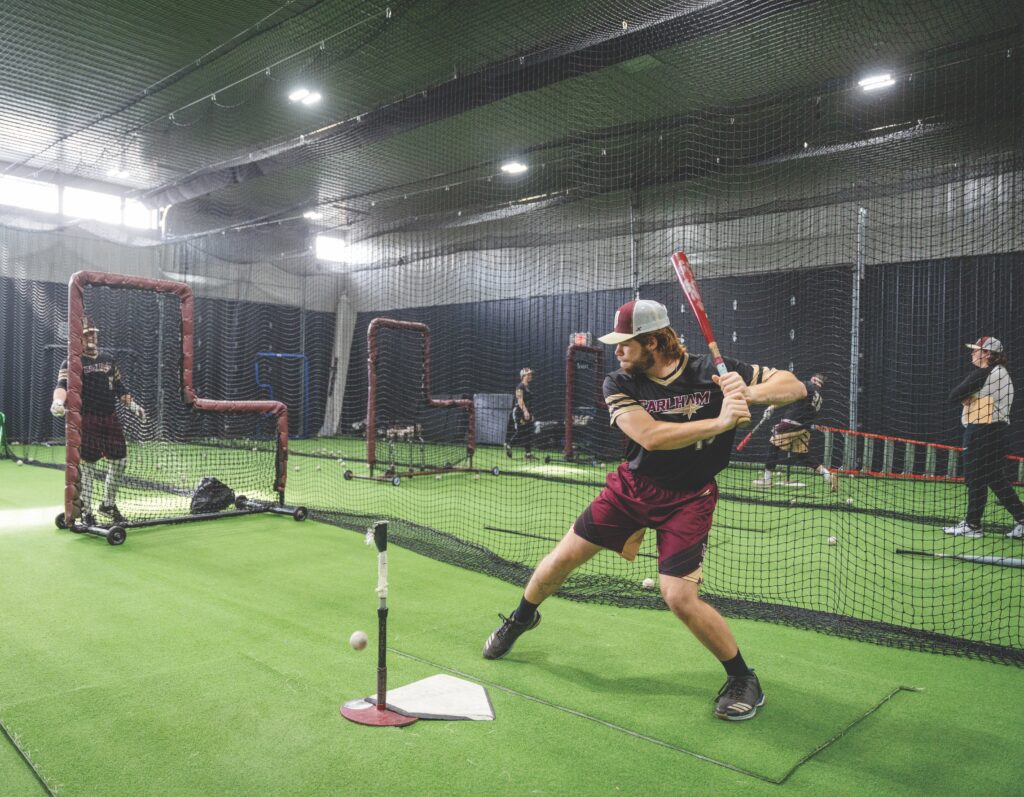
The Earlham College varsity baseball and softball programs began the 2024-25 academic year with a new indoor practice and training facility that rivals many of the nation’s top intercollegiate programs.

Many NCAA Division I schools can’t say they have an indoor training facility of this caliber.

-Steve Sakosits, head baseball coach and senior athletic director

Construction of the Bud McCollum-Earlham College Baseball Hitting and Pitching Lab finished in summer 2024 with usage ramping up in the winter months. The facility measures 80-by-104 feet and has six lanes that can be customized for pitching, batting, fielding and footwork drills.

“Many NCAA Division I schools can’t say they have an indoor training facility of this caliber,” said Steve Sakosits, Earlham’s head baseball coach and senior associate athletic director. “Not only will it provide a year-round facility to support the development of our players, but it will help us recruit a better student-athlete at the Division III level.”

The new training facility is the result of a major gift from Randy Sadler ’73 and Melissa Sadler, and additional support from Charlie and Esther Krieger and proceeds from a fundraising campaign led by the baseball program. The facility is named after Bud McCollum ’72, Randy Sadler’s former teammate.

Leaving a mark

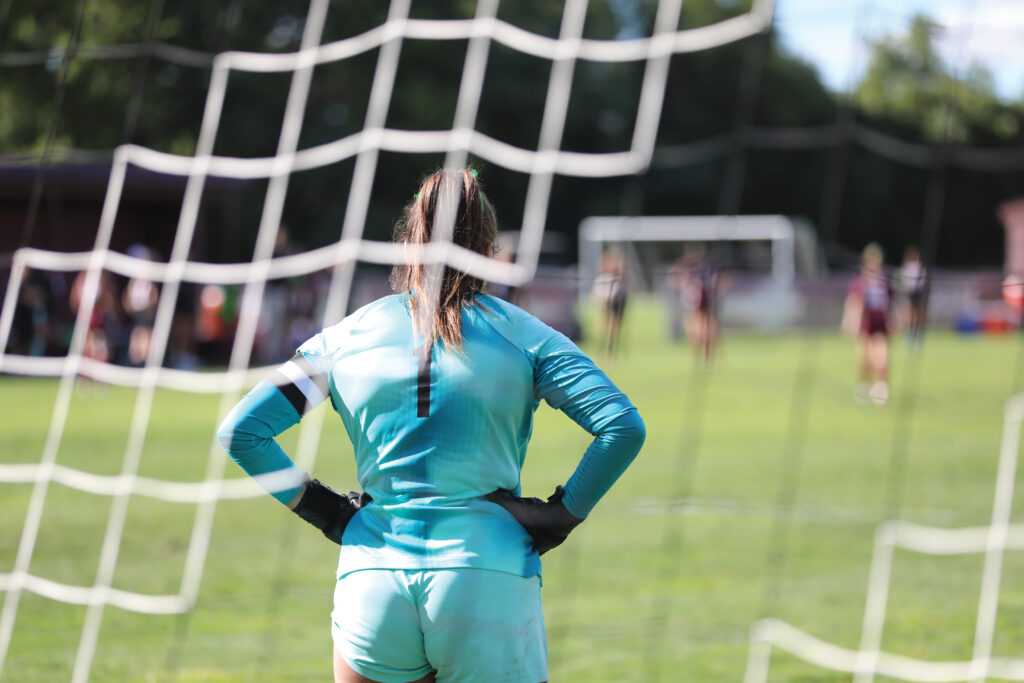
Makayla “Mak” Hurey ’25 has redefined resilience and excellence for Earlham’s women’s soccer team, breaking records while anchoring a program that found strength in her unwavering defense, even during challenging seasons.

“I was always told to leave your mark by my coach,” Hurey says. “So I went out and just constantly played like it was the last game I ever played.”

On teams that struggled to score goals, Hurey did just that by keeping the ball out of the net at a clip that has not been seen before by the Quakers.

Hurey is graduating as the Earlham women’s career record holder for shutouts, posting 16 over the course of four seasons. In her senior year, she posted six shutouts, including two back to-back games that ended as 0-0 ties against Mount St. Joseph and Transylvania, two of the Heartland Collegiate Association’s best squads last fall. Mount St. Joseph won the conference title and Transylvania finished third by season’s end.

These were regular season games, “but represented a lifeline to the team to stay in the running for the playoffs, and gave proof to the team that they could compete with the top of the conference,” says Lydia Harvey ’19, head coach for women’s soccer at Earlham. “Her four years here at Earlham have seen the total 180-degree turnaround of the program. From the moment we met I knew she was going to be impactful.”

In Hurey’s first year she posted one shutout. That followed with seven during her sophomore year. She posted two more as a junior before riding six shutouts to a record in her final season. In her career, she was a two-time HCAC defensive player of the week and was named first team all-conference. Hurey was ranked No. 1 in saves (115) and No. 1 in saves per game (7.67) in conference. She was also tied for No. 1 in regular season shutouts and No. 2 overall in conference. Well above any other HCAC goalkeeper, she’s currently ranked No. 62 in the NCAA Division III’s Top 100 leaderboard for save percentage.

Also as a senior, Mak was elected as captain by her teammates – and voted as team MVP. “I have always considered myself a leader,” she said. “I was team captain in high school and have been a goalkeeper most of my soccer career, so leadership came to me as I stepped into the role.”

Leadership hasn’t come easy for Hurey, though. “We’ve worked with Mak to help her find her voice,” says Harvey. “Her leadership came off a little harsher at first but she’s learned how to reflect on how her words and actions impact teammates. She understands better how to meet people halfway.”

“After time,” says Hurey, “I learned that I need to take into account what people need from me in order to be a successful leader. I grew not only as a leader but as a person over the four years of being a part of the team and I believe it is going to better me as a person overall for when I start coaching players.”

As equally influential as her team is Hurey’s brother Cayleb Paulino, who works as the head women’s soccer coach at Ashland University.

“Growing up, he was always my role model through school and sports,” says Hurey. “As we both got older, it was kind of a coincidence that I wanted to follow in his footsteps.”

Hurey plans to continue in his footsteps and move on to graduate school, where she hopes to find an assistantship specifically focusing on coaching women’s teams.

“She’s been an amazing leader and player,” says Harvey. “She’ll definitely leave some big shoes to fill.” ■

Earlham Rhodes Scholar achieves new career milestone

Hashem Abushama

Hashem Abushama ’17 was named an Associate Professor in Human Geography at the University of Oxford and is serving as a Tutorial Fellow at Oxford’s St. Peter’s College.

“Hashem’s appointment, especially at such a young age, is nothing short of a monumental achievement,” said Earlham Associate Academic Dean James Logan, who had Abushama in class. “This Earlham alum could well be on course to be one of the most important public intellectuals and justice advocates of his generation.”

Abushama, one of the two first Palestinians to be awarded the Rhodes Scholarship, received his doctorate of philosophy in human geography and a master’s of science in Refugee and Forced Migration Studies from Oxford University. As an Earlham student, he was a Peace and Global Studies major and was deeply involved in student justice movements, including Students for Justice in Palestine and Black Lives Matter.

When he first arrived at Earlham, Abushama had his sights set on pre-medical and economics studies.

“I did one course with PAGS and fell in love,” said Abushama. “PAGS was a transformative experience for me.”

“Hashem was always so driven,” said Joanna Swanger ’90, PAGS director, “and he clearly wanted to do his very best at all times. When you combine this with his rather playful spirit, it was easy for me to match that energy.”

When Abushama had to miss class to interview for the Rhodes Scholarship, he was terrified he would miss a quiz.

“He was terrified of ever missing a quiz,” said Swanger. “I emailed him while he was actually on the airplane coming back, and said, ‘There’s a quiz you need to complete within the next 12 hours. Closed book.’” Abushama, of course, completed the quiz — and both he and Swanger got a laugh out of it afterward.

One course in particular shook his world: Global Dynamics and World Peace. “I purposely gave it a grandiose title to gently mock the sheer absurdity of the enormity of what we’re up against,” Swanger said of the course. Through the course, Abushama began a habit of submitting extra notes to Swanger on the readings, and she would provide feedback.

“To see a student this invested in going above and beyond was exciting for me, and I was happy to put in this kind of labor,” said Swanger. “I think most Earlham professors are responding in a similar way when they see this kind of effort from students, and this is indeed what makes Earlham known for its commitment to teaching, which at Earlham — because of the luxury of getting to know our students so well — is often a highly tailored craft personalized for students.”

Today, Abushama uses his Earlham experiences as a student to inform how he approaches the classroom as a professor.

“I had a lot of close attention from Earlham professors,” he said. “Being in conversation with teachers is something I hold dear to my heart. The more of a teacher I become, the more I appreciate it, because I understand how much labor goes into doing that kind of work, making yourself available to and being invested in your students.”

Abushama hopes to amplify the stories of Palestinians and oppressed communities around the world as he strives to understand how struggles are connected. He’s working on a book and recently published a prize-winning essay, “A Map without Guarantees: Stuart Hall and Palestinian Geographies.” He’s also excited to explore creative writing as a means to widen the discourse of these subjects outside of academia. Also on his bucket list? “I hope to visit Earlham!” ■

Q&A with Earlham President Paul Sniegowski

President Paul Sniegowski is in his first year at Earlham College. The Quaker map for Principles and Practices drew him to the work and will inform his tenure.

In August 2024, Paul Sniegowski arrived at Earlham College as its 21st president, bringing three decades of experience as a professor and dean of the University of Pennsylvania’s College of Arts and Sciences. A native Hoosier returning to Indiana after years on the east coast, Sniegowski has embraced the opportunity to lead Earlham at a transformative and unique time. In this Q&A with Earlhamite magazine’s writer/editor Jay Kibble, the president reflects on his goals for the college.

You’re originally from Indiana.

I was born in Toledo, Ohio, but grew up in South Bend. We moved when I was about 2. It has, in fact, been a homecoming for me. Indiana feels familiar in all the ways. Prior to this I spent about 30 years out on the East Coast. Most folks on the east coast consider the Midwest to be flyover country, but if you’re a Midwesterner, you know that the beauties and the likes of the Midwest are there. They’re more subtle things. In addition, my mother turned 90 this year and still lives in South Bend. It’s nice to live closer to her and be able to buzz up to her occasionally.

What has it been like returning home to serve as Earlham’s 21st president?

It’s not just returning home, though, it’s also returning to serve Earlham. Our son, Ben, attended Earlham, and graduated in 2023. My whole life I’ve known about Earlham College. I’ve known people who attended here, and people who almost came here for a job, myself included, prior to accepting the presidency. In a way, it’s kind of a rounding off of a career, a sort of arrival somewhere, to me. I’m working very hard here as president, but I am a retired person. I retired as a professor of biology at Penn, so this job is not a stepping stone to something else for me. It’s something I want to do to serve a college I’ve always admired, as has my son and so many other people.

What was it about Earlham that drew you to the presidency?

There is, as I mentioned, the fact that the family is here in Indiana, that Ben attended here, and those are kind of part of the larger constellation of things that drew me to Earlham. As was the fact that I almost took a job here 20 years ago. I think the other element that I haven’t addressed, but that I believe in so deeply about Earlham, is its Quakerness. We don’t actually have that many Quakers on campus or in our faculty — including me. I’m not a Quaker. But our Principles and Practices that are our legacy from the Quaker founding of our College are things that have been meaningful to me throughout my life. At this particular point in my life, and to be honest, at this particular moment in the U.S. and in the world, the opportunity to serve a place that stands for those things like this place does was just an enormous attraction to me and a real draw.

You spent much of your career teaching in the sciences, but your academic background is quite diverse. How did that help you in your career?

There are commonalities to teaching in any subject. My first serious experience at teaching was teaching children to play the violin. I was a violinist and went to Indiana University Jacobs School of Music before I went to grad school in biology. For a while there, I made a living as a freelance music teacher while also taking classes because I knew I was going to eventually make the transfer over to biology. When I went on to Penn, one of the things I did almost every year was to teach one or more of the large intro to bio courses, and these are sometimes large classes, as many as 220 students. What I really cherished in those classes, in addition to trying to interact with the class in the classroom, I really cherished office hours and seeing the students who’d come to visit. Again, that’s that one-on-one approach. I really do trace that back to my experience teaching violin.

People might be surprised to know that you’re teaching this semester. How are you balancing the presidency with the demands of classroom teaching?

It’s a course I have taught before at Penn. It’s Biology 205, an introduction to evolution. You don’t have to be a biologist to take it. It’s a seminar course. The heart of the course is to read Charles Darwin’s “Origin of Species.” It’s a book that a lot of people talk about but not many have actually read. I’m also going to bring two other books that are also in that category. David Foster Wallace’s “Infinite Jest,” and “War and Peace.” Just like the students will have to do reports on “Origin of Species,” I’ll do reports on either “Infinite Jest” or “War and Peace,” whichever the class chooses. I can’t stand to not teach, that’s a big reason for teaching the biology course. But more importantly, teaching is one of the fundamental things we do with each other as human beings. We actually teach one another when we have a great conversation. But there are other ways of teaching, too, and it’s what Earlham has such a high reputation for. It’s like oxygen to me. When other things aren’t going well, and you have a good class, you can say ‘Well, at least I’m doing something for Earlham.’

What do you hope to accomplish before the end of your first year? What are your long-term goals?

Our new provost, Lori Schroeder, and I have worked hard, and I think we’ve had some success in building trust with our faculty, to let them know that we care about them and we care about the institution they represent. I’d love that trust to carry on through this year and into subsequent years. We have some difficult work to do. The environment for higher education, both in our state and nationally, is tough right now. It’s tough politically. Starting this year, there will actually be a decline in the number of college-age young people graduating high school.

These are real challenges for us. In the first six months here, Lori and I have talked really openly with the faculty about community, about the challenge of growing Earlham’s enrollment. We already have some plans in place to meet that challenge. We just rolled out the Get5 program, where admissions faculty are doing the administrative work of matching prospective students with faculty for dialogue. Whenever I’ve talked with alums, I’m always told that what they ultimately loved about Earlham was the quality of the faculty and teaching, but what made them choose Earlham was the interactions that they had with faculty during the application and decision-making process. I think Covid eroded some of that. It eroded so many things, and I think it eroded some of that. So we’re going to keep expanding those kinds of efforts. Many new academic programs have been introduced to the curriculum in recent years.

Do you see that trend continuing?

We are exploring a physician’s assistant program that has to be approved by our faculty. We are contemplating other possibilities consistent with our mission, and in service of enrollment and sustainability, but nothing is certain at the moment.

What about athletics? Is there a chance football returns?

I have had conversations with many alums about this, people are quite passionate about football. I grew up within listening distance of Notre Dame stadium, so I love college football. If football comes back, it will take a while. We’ll have to do it right, if we do it, which is to say we’ll have to set it up so that it’s financially sustainable and a reasonably competitive part of Earlham athletics with the other teams we play. So those are some things we’d need to consider — but it’s possible.

Many Earlham community members have remarked that you have frequently been spotted at community events. What is your favorite memory so far from your time as president?

I wish I could get out to more events, if I’m honest, but I try to do a different thing as often as possible. So far my favorite memory was during Homecoming, running the 5K. I didn’t do nearly as well as I expected to, but I did finish.

What is your favorite place to relax on campus?

Back Campus. You get back there, especially among the horse paddocks and fields, and it reminds me of walking in England. When I was a kid, my family spent a year in Oxford. We were out in the country, and we’d go walking. You just feel so far from everything out there.

President Paul Sniegowski with his “First Dog,” Willa, during New Student Orientation Week

Willa, the First Dog, is often seen with you as you hike Back Campus. How’s she doing?

We usually take her on a walk into campus once a day. She loves running into students and faculty, she’s very people-oriented. The huge field behind the 712 College Avenue house where we live, I mean Willa has never had a field that huge where she can just run and not have to worry about turning back. She was a little anxious when we first got here, but she’s settled in nicely.

If money were no issue, the sky was the limit, where would you want to see Earlham in the next 5-to-10 years?

I’d like to see Earlham at a place where money is no issue. I’d like to see us moving towards a status where students who have applied to go to Earlham College are biting their nails, hopeful to get in. ■

Work Among Friends

In offices scattered across Earlham’s campus, staff members work on the often-unseen aspects of keeping a college moving. They recruit prospective students, raise funds for new programs, ensure student safety, maintain campus compliance with a myriad of federal requirements, build relationships with employers and donors and community members—all in the service of helping Earlhamites do big things. 

Some of these administrative faculty have worked at the college for decades. In conversations with these longstanding Earlhamites, each spoke with nostalgia, reflecting on the people who came before them as anchors of the community—or, as Susan Hillmann de Castañeda calls them, weighty Friends.

These anchors offer a steady presence and unwavering commitment to the Principles and Practices that have shaped Earlham. Some are Quakers—but not all. 

And although they don’t always realize it, they are among the new stewards of the Earlham spirit as they go about the quotidian business of keeping the college moving forward.

Susan Hillman de Castaneda

Weighty Friends with Susan Hillmann de Castañeda 

The day after Susan Hillmann de Castañeda ‘93 got married—she also walked across Chase Stage to graduate from Earlham. Soon after, she moved to Bogotá, Colombia, with her husband. 

When the political situation took a turn for the worse, they decided to move back to the U.S. When Susan told her husband she wanted to return to Earlham, he asked why. 

“I knew I needed a good answer, so I told him: ‘Every day as a student, I felt supported and challenged in equal measure. I want to go back to that.’” she said. “He said, ‘OK, for two years.’ That was 25 years ago.”

Upon returning to the Earlham campus in 1999, Hillmann de Castañeda worked with nonprofit management professor Monteze Snyder and Trayce Peterson ‘82 to create a handbook for their consensus-building workshop project. After that, Hillmann de Castañeda moved into admissions, where she has worked ever since, and serves as the international student admissions counselor.

“I draw joy from talking with them,” she said of prospective international students. “I’m getting to hear their hopes and plans and expectations, and how Earlham could be that place where they can continue to explore and discover and reach their goals.” 

Making the switch from student to employee has shown Hillmann de Castañeda the “behind the screen” work. 

“You get to see behind the screen and realize what’s really going on, how much goes into making the college work and keep it going,” she said. “And over time, the change in professors and personnel is something you feel sad about. People we knew as ‘weighty Friends’ during my time as a student have retired or gone.” 

Stan Hill

Building friendship with Stan Hill

Recruited to the football team, Stan Hill ‘93 came to Earlham from a conservative small town in northeast Indiana. 

“I was so out of my comfort zone—and it was one of the most amazing decisions I ever made,” he said.  “One of my first experiences here was practicing two-a-days with the Doshisha Hamburgers, the first Japanese-American football team to come to the U.S. The media were all there to document it—and what an amazing experience for this Midwestern kid to show up and have this. My locker mate was from the West Bank. To sit there after practice and talk to him about the struggles of his life to that point gave me real perspective.” 

After graduation, Hill’s football coach talked him into staying on as an intern. From there, he moved into roles in admissions, the MAT program, and finally, advancement. Each step of the way, Stan has seen his jobs center around one thing: building friendship. 

“I travel all over the country, meet with alums, but it’s all about relationship building,” he said. “I feel that’s the cornerstone of my whole career: building relationships with others and working toward a goal together. Usually we’re just telling stories about Earlham. It’s a place we all really loved, and my job is to share what’s happening and continue that relationship with the College.”

Embracing community with Bonita Washington-Lacey

Across the Heart in Earlham Hall, you’ll find the offices of Student Life—but whether you’ll find Bonita Washington-Lacey ‘78 inside is anyone’s guess. With an Earlham career that has spanned decades, Washington-Lacey is just as likely to be found discussing college strategy in the president’s office, meeting with students in the cafeteria, or any place between. 

Having attended a Friends school in Detroit, Washington-Lacey was looking to attend a Quaker college—and landed at Earlham. After graduation, she attended a year of graduate school before returning to the Earlham campus to work as an admissions counselor. 

Did she expect to stay after that first job? “Absolutely not,” she said. 

But she stayed—and has chosen to stay year after year for the people in this community. 
“When my life was in a place of vulnerability, this community stood by me,” says Washington-Lacey. “When my daughter was ill, when my husband died—I was surrounded by compassion, prayer and uplift. You don’t get that many places, but I found that here. That means a great deal to me, and there’s not much I wouldn’t do for this community.” 

Because Earlham was fully present for her, Washington-Lacey has dedicated her career to being fully present for Earlham and its students. From admissions, to student life, to academic affairs and back to student life, she remained focused on the Earlham student experience as she has helped form programs such as LIFT for first generation students, the Honors program, Training for Academic Success for student-athletes, and more.

“My hopes and dreams for Earlham are to see the College continue to grow enrollment,” she said, “[For those] who want to learn, who are open to listen across different perspectives — and to have more and more alumni come back and engage with us.” 

Kim Tanner

Fostering transformation with Kim Tanner

Kim Tanner ’90 was wrapping up her time as an Earlham student just as Hill and Hillmann de Castañeda were beginning theirs. After graduating, Tanner started to work on her graduate degree and began teaching at Richmond Community Schools. During an alumni council meeting, she heard about a new program involving alums in admissions.

“I was so excited, I ran across campus to the admissions office to tell them I wanted the job. I couldn’t contain myself — the spirit moved me in the meetinghouse when I heard about it,” she said.

After two years in admissions, Tanner moved into advancement — where she has held almost every position in the office.

“I love what Earlham stands for,” she said. “I love what we do in the world at large. I love being a part of an organization that transforms students’ lives, because it transformed mine.”

It’s easy, Tanner said, to be nostalgic for the old days, but she knows the values are ageless.

“At the core of Earlham, what we do and how we do it remains the same,” she said. “The way students engage with Earlham, what they care about — they care about the world, about making a difference. That’s not just rhetoric. I’ve seen Earlham grapple with difficult decisions and difficult governance issues. The consensus process and shared governance has shone through each time, even when it’s difficult. The fact that we keep working at it, and aspirationally hold ourselves to it — I love that. Earlham feels like home to me. I can’t imagine not being here. I don’t know where Earlham ends and where I begin.” ■

Birds of a Feather

KASUN BODAWATTA ’15 came to Earlham pretty sure that he would major in geology. That changed when he happened to enroll in an ecology class taught by Wendy Tori, Professor of Biology and Martha Sykes Hansen Endowed Chair in Biology for Ornithology.

On the first day of class, Tori introduced her students to manakins, a family of small, tropical birds that are known for their spectacular courtship dances. But as the video played in the background, Tori didn’t just sit and watch quietly as the birds did their thing. Much to the delight and amusement of her students, she danced along with them.

“She had so much energy. And she was super excited to show this video of a manakin dancing while she was also dancing,” he said, still laughing at the memory of that first class more than a decade later. “She was very passionate about the birds, and I thought, this is super cool.”

That moment, and the semester that followed, wound up being a revelation: for Bodawatta, the allure of gems and minerals simply couldn’t compete with the wonder and beauty of the living world. He changed his major to biology and over the course of his career at Earlham he took several more classes with Tori.

Today, he is a full-fledged evolutionary biologist in his own right. He’s a principal investigator on his own research projects and has collaborated on cutting-edge scientific research with Tori, his former professor. Both are delighted that their academic relationship has continued long after the final grades were recorded for that first class.

For each, it’s a true full-circle moment.

“Earlham was special. You have a lot of opportunities to do research with the professors and have these experiences,” said Bodawatta, who today works at the University of Copenhagen in Denmark with a focus on microbiomes and parasitic infections. “It was so nice to learn from Wendy. And now it’s so much fun to work together and then go to places, see birds, and also collect data for interesting research questions.”

Tori, who has now traveled with her former student on research trips to places as far-flung as Papua New Guinea and Peru, agrees.

“We haven’t stopped working together,” she said. “It’s been a great long journey, which has been very rewarding.”

‘Birds are so amazing’

What is it about birds? It’s not that they’re a rare or hard to find commodity. There are around 11,000 known species that live on every continent and call every kind of habitat home: ocean, desert, mountains, forests, grasslands, freshwater lakes, rivers, and beyond. Birds can have vibrant plumage or dull camouflage, and can be as small as the miniature Bee Hummingbird, which weighs less than a dime, and as large as a nine-foot-tall ostrich weighing as much as 350 pounds.

Although they are as omnipresent as they are diverse, there’s nothing ordinary about them, Tori taught her students.

“Birds are so amazing. They’re easily seen, vocal, beautiful, colorful,” Tori said. “They can bring people together and they can provide enjoyment of nature wherever you are.”

But that’s just scratching the surface of what birds can do to help us better understand our world.

“They’re super important. They play many important roles in the ecosystems, and there’s already a lot of information available about them,” she said. “So you can ask complex questions related to evolution, conservation, management, ecosystem health, among many others.”

As a teacher and researcher, it’s clear that Tori is deeply devoted to both her subject and her students. Close to Earlham, she’s involved in the Eastern Bluebird and Tree Swallow Project in which she and students–including Bodawatta as an undergraduate–study reproductive behavior in these species.

Farther afield, she had a long-term Amazon manakin project in which she studied the birds’ “lekking” mating systems, which she describes as akin to a “male discotheque.”

Tori, who has now traveled with her former student on research trips to places as far-flung as Papua New Guinea and Peru, agrees. As a teacher and a researcher, it’s clear that Tori is deeply devoted to both her subject and her students. Close to Earlham, she’s involved in the Eastern Bluebird and Tree Swallow Project in which she and students — including Bodawatta as an undergraduate — study reproductive behavior in these species. Farther afield, she had a long-term Amazon manakin project in which she studied the birds’ “lekking” mating systems, which she describes as akin to a “male discotheque.”

In a collaboration with Jaime Coon, assistant professor of biology and environmental sustainability, she’s looking at how grassland birds in the Grand River Grasslands of Iowa and Missouri are affected by climate change and land management strategies like grazing and burning. Many Earlham students are helping with this research, Tori said.

A singular student

Bodawatta’s aptitude for science and learning was apparent from the beginning, Tori said. He even had enthusiasm for a work-study job taking care of the earwigs she used in her animal behavior class.

“You get that feeling that this student has this energy inside. I mean, he was even willing to work with earwigs, which are not the most flashy animals,” she said. “He was ready to do anything, excited about learning stuff and doing stuff. And so as soon as I had some bird-related research, we started working on it together.”

As an undergraduate, he contributed to the Eastern Bluebird and Tree Swallow Project and traveled with Tori to Ecuador for her research with manakins.

When a student connects with a professor and a subject at the right time, it’s like a key sliding into a lock. Turn the key, and a world of experience can open up for a young mind eager to learn, and that is what happened with the young scientist.

The spark lit during Tori’s ecology class never went out for Bodawatta. After graduation, Bodawatta went to Denmark to pursue his masters’ degree in ecology and evolution at the University of Copenhagen, then his doctoral degree in avian-microbe symbiosis from the Natural History Museum of Denmark at the University of Copenhagen.

A tradition of collaboration

In 2019, as a graduate student studying the gut microbiomes of wild birds in Papua New Guinea, he was able to invite Tori to join him. He figured she’d jump at the chance, and he was right. That small island nation in the southwestern Pacific Ocean is home to birds-of-paradise, a lekking species known for the males’ vibrant plumage and dramatic dances that was at the top of Tori’s bird bucket list.

“It’s the place I always dreamed of going and seeing these birds,” she said. “Kasun asked, ‘Do you want to come?’ And I said, ‘Oh my God, I can’t believe this is happening.’”

Keeping a tradition going, Tori brought two Earlham students with her, Ian Shriner ’21 and Sam Pigott ’21, for what became a memorable research trip. The students, working with the guidance of the two scientists, studied factors affecting feather mites and their avian hosts on Mount Wilhelm, the highest mountain in Papua New Guinea.

For Bodawatta and Tori, it was a joy to work with Shriner and Pigott in the field and work through the stages of the scientific process with them from experiential design and data collection to publishing the results in the Journal of Avian Biology.

“It was a great experience to mentor these students together and to have the opportunity to learn so much about the local birds,” Tori said.

As for the birds-of-paradise, the first day the research team woke up in Papua New Guinea, they could hear the birds singing in the rainforest nearby. They searched for them, and eventually found some and even saw them dancing.

“It was so amazing seeing them. It was just like a dream come true,” Tori said. “Beautiful, beautiful. It’s hard to even describe in words the feeling of seeing them. I had waited so long to see them. So amazing.”

Pigott, a biology major who is now a documentary filmmaker, said that the month he spent living and working in the mountains of Papua New Guinea — his first research trip outside the U.S. — was incredible.

“I’d done field research before that, but this was like really hardcore science research,” he said. “Papua New Guinea, for birders, is like heaven. There’s no other place in the world that has more unique, rare species. So to go with two ornithologists was just amazing. It was everything you would imagine it to be. And Wendy and Kasun were both super supportive and helpful the whole time.”

The trip, and his other classes with Tori, made an impression on Pigott. After graduation, he was selected for a Watson Fellowship to travel the world and examined what he calls the social side of conservation. Through his travels, he heard many stories about environmental crimes that have taken place at private nature reserves and about greenwashing, which happens when a company or organization makes misleading claims about how environmentally friendly its practices or products are.

“I always have a camera on me,” he said, and began to document what he was seeing. Pigott joined forces with Shriner, also a biology major, to make a documentary, How to Get Away with Greenwashing. They showed a 20-minute version to a receptive audience at Climate Week NYC last fall, and are actively fundraising now to finish a longer version that they hope will be widely released.

“Even though I don’t want to be doing data collection science exactly, one of the main reasons I want to stay in that field is because of Wendy,” Pigott said. “I think she and Kasun both did a very good job of nurturing a passion. I would say they definitely had a very profound impact on my interests. And certainly Earlham is an institution with a very strong social justice orientation. It’s hard not to see things with that perspective, and hopefully I can bring that through film.”

In addition to bird microbiomes, Bodawatta is also asking questions about what mosses can reveal about the surrounding environment. Often, birds, mammals, and insects can be secretive and the vegetation where they live can be dense. Finding these animals to study them in the wild takes time and resources that sometimes scientists don’t have.

Mosses, on the other hand, don’t move and aren’t hard to find. Bodawatta is hypothesizing that the mosses act as a recorder of the life happening around them through the accumulation of environmental DNA from the air and the water. By swiping the surface of the moss with a cotton swab, analyzing the DNA extracted from the swabs, and comparing the sequenced genetic material to what’s already known about birds, mammals, insects, and more, it may be possible to obtain a very good record of the biodiversity of the environment.

“It’s a simple method. If it works, it’s a good method,” he said. “It can have useful implications for conservation strategies and monitoring programs.”

Right now, he’s working to prove whether his hypothesis is good, and has received a grant from the Villum Experiment Programme to help him do that. The Danish program is aimed at out-of-the-ordinary research proposals that challenge the norm and have the potential to fundamentally change the way people look at important topics.

“You come up with new, crazy ideas,” Bodawatta said. “Usually they support things that shouldn’t work, or that other grant agencies might not support because it’s a high-risk project.”

And when it came time to go into the field to start testing his “crazy idea,” he reached out to a familiar person: Tori. They needed to go to a place in the tropics with well-researched biodiversity in order to test the methodology and decided on Peru, where Tori grew up and where her parents still live.

A haven of biodiversity in Peru

Last summer, the scientists, along with Tori’s husband, José-Ignacio Pareja, lecturer in nutrition science and science technology learning specialist at Earlham, headed to three sampling sites in southeastern Peru that included Manù National Park located at the meeting point of the tropical Andes and the Amazon Basin. The park is a UNESCO World Heritage Site, celebrated as a haven of terrestrial biodiversity, and features high grasslands, cloud forests, mountain forests, and lowland rainforests.

To get to one of the sampling sites at the Cocha Cashu Biological Station in the park, they had to embark on a two-day journey crossing multiple streams in the Andean cordillera, then an eight-hour boat ride up the Manù River.

“Then we got to this pristine forest,” Bodawatta said.

They were there for a little more than three weeks, during which they gathered many DNA samples off mosses and Tori even saw her first jaguar sitting by a forest stream. The research trip was idyllic, but getting the permits to collect and export the cotton swabs with their DNA samples was much less dreamy.

“What Kasun and I were doing in that research project is really new. And there’s no specific laws to apply for research permits to work with environmental DNA yet,” Tori said. “There’s no procedure on how to deal with something so new in Peru.”

The Peruvian government, erring on the side of caution, did not allow the scientists to take all the samples out of the country. Tori had a flash of inspiration: why not bring them to her parents’ home and store them in a small refrigerator there? That’s what they did, and the samples stayed there for four months until she was able to send them safely to Denmark, where a research assistant is currently working on them in the lab.

“Wendy was the backbone of the project. Everything needed to happen in Spanish,” Bodawatta said. “If she wasn’t there, we wouldn’t have been able to do the field work or collect the samples, or even process them right now. She managed to find people that might know the answers, or could try to get the answers. As an outsider, I would not have been able to do it.”

Their long friendship and trust meant that he knew he could count on her to save both the samples and the study.

“I think it made it possible to say, ‘OK, this will work, one way or another. Do not worry,’” Tori said.

Her parents — who had her disinfect the small refrigerator very carefully after she removed the environmental DNA samples — became a part of the study, too.

“They were happy to do it,” Tori said. “My dad said, ‘Well, make sure to put me in the acknowledgements after my refrigerator was full for four months.’”

For the two scientists, the future of their work together is full of possibilities. One thing is certain: they will keep on collaborating on research that will help to answer some of the world’s mysteries. Birds, environmental DNA, and more, they are ready to answer the call. ■

Written by Jay Kibble

Help Us Laugh

Liza Donnelly at her recent artist talk during Homecoming Weekend 2024

When Liza Donnelly ‘77 was a young girl, she found socializing difficult. “I was painfully shy, growing up,” she said. “Drawing helped me cope.”

She remembers getting started in cartooning with one mission in mind: to make her mother laugh. Her mother was a housewife in a generation that didn’t offer women easy choices, and the girl intuited her mother’s unhappiness. “I was home sick from school one day,” Donnelly says in her upcoming documentary Women Laughing. “I was 7 years old. My mother gave me some paper, and I started drawing these cartoons. When I drew these funny pictures of people, it made her laugh. I was hooked.”

Not only was she hooked, but she went on to become one of the first women cartoonists in a magazine beloved for cartoons: The New Yorker

Earlham College’s Ronald Gallery in Lilly Library exhibited Donnelly’s work, including a teaser of the documentary, during Homecoming and Reunion Weekend on October 19, 2024. Organized by Christian Adams, art curator for the gallery, the event offered attendees a view of Donnelly’s work in The New Yorker, where her career has spanned 40 years. 

For Adams, the exhibition was a labor of love and a dream.

“It was a pleasure to have Liza Donnelly come to Earlham and give a show and talk on her life and work,” said Adams. “It was a wonderful afternoon, and our students and alumni had the opportunity to be present and hear her talk. I truly believe she, along with many other Earlham graduates, can help us better understand the times in which we live and are making the world a better place.”

For Donnelly, the event was almost like coming full circle, to where it all began in the 1960s.

“This is the period when I grew up in Washington, D.C.,” said Donnelly. “Political assassinations, the Civil Rights movement, the women’s movement, Vietnam War, abortion, women’s rights, political scandal. Those are the things that really made me who I am, in part. They shaped my work as well. I’m also shaped by my Quaker upbringing, which said to me, ‘Do something.’” 

Reporting through drawing

Donnelly’s cartooning career has taken her from graduating from Earlham to the glitz and glamor at the Oscars and, more recently, to reporting on presidential debates. Her Substack Seeing Things includes slice-of-life cartoons, political fare and frequent live drawings, which she began during former President Barack Obama’s administration.

“Every year I watch the State of the Union, and that year I was watching – I think it was Obama’s first one – I was a big fan of Twitter [now X], and I’d just gotten an iPad. I started drawing what I saw and sharing it immediately on social media,” she said.

She uses the digital notebook Paper for her drawings, and with that program, she can easily send out creations to social media.

“I sent quick drawings out on Twitter with these much stronger, bolder line drawings than some of the stuff that I do, but still my style, with commentary in the tweet,” she said. “Twitter was young at the time, and people weren’t really drawing on there. It just caught on, and I realized it was something that I enjoyed doing for national or international events. It was a way to comment, converse, report what was going on.”

If the number of followers or views she has on her social media or readers of her Substack are anything to go by — 64,000+ followers on Substack alone, with 22,000 on Instagram and 6,200+ on Facebook — the live drawings seem popular and bring people together.

“It became something I’m incredibly passionate about. It’s something no one else was doing with digital tools,” she said. “This quick communication with people, something I think I was the first to do with social media and the iPad, it was a new kind of reporting, and it’s a way to grab people’s attention in a way that words don’t, and it provides a somewhat quieter and unique view of political, national or international events.”

Emma Allen, cartoon editor of The New Yorker, agreed.

“She’s such a pioneer of that form,” said Allen. “And it’s something that’s beyond the internet, especially as we’re now trying to engage people on social media platforms. It’s become an exciting new way to think about an old thing.”

It’s no secret that the internet is ablaze with memes and humor. Allen views cartoons almost like proto-memes, slices of humor and history that may be artifacts of a dying publishing form, but that can be revived and given new life online in new, exciting ways. “When it comes to single panel or gag cartooning, we’re one of these last bastions in terms of who’s publishing this type of thing,” she said, referencing The New Yorker. “Cartoons can have such viral life on the internet and Instagram. Even older ones that end up resurfacing, people go wild for those.”

One such example is a cartoon Donnelly drew of a busy city street. Passersby walk by a man at a hotdog stand selling hot dogs for $2, soda for $1.50, and world peace, which he lists as “priceless.” He sits at his stand waiting for a customer, any customer.

“In some ways, that’s me,” said Donnelly, referencing the man working the stand trying to peddle peace, a topic she has repeatedly referenced in her career.

Activism awareness

Key moments in Donnelly’s four-decade career at The New Yorker have included 9/11 and the Danish cartoon controversy of 2005. Prior to 9/11, Donnelly had done political cartoons for the magazine as early as the 1980s. But 9/11 shook things up for her. “It made me start wondering what I was doing with my life and if I could be doing more,” she said. 

When cartoons of the Muslim prophet Muhammad were published by a Danish newspaper in 2005, they were met with outrage and led to riots, protests and violence around the world. The controversy sparked debate about the scope of free speech and ignited Islamophobic rhetoric. While 9/11 shook up Donnelly’s world and incentivized her to make more of an impact politically with her career, the Danish cartoon controversy created a “big shift in thinking about how powerful cartoons can be,” said Donnelly. “And that coincided with the rise of the internet. It showed the power of humor and how it’s a tricky subject.”

Tricky, definitely, but not a subject she shies away from by any means. “For me cartoons are about communication, about dialogue between people,” she said. And when that dialogue inevitably leads to challenges and necessary change, she’s not afraid to ask the hard questions.

Donnelly has also been attuned to women’s rights throughout her career. “I’ve always known that I’m in the minority in my business,” she said. “When I started at The New Yorker in 1979, I was one of four women drawing cartoons out of maybe 50 men. Although a feminist, it didn’t occur to me to do cartoons about women’s rights at the time, but being a cartoonist and a woman, it was gratifying that I was among a few women who broke that small glass ceiling.”

She talks about an experience she had on a panel of women cartoonists for the American Association of Editorial Cartoonists. There weren’t many women who were political cartoonists at the time. “While I knew we were in the minority,” she said, “I began to seriously explore the question, ‘Why aren’t there more of us doing this?’ And when I got to the panel, it was just a sea of men, all male political cartoonists. It was a visual hit in the head: This is not right.”

Thus began her interest in researching the history of women in cartooning, particularly at The New Yorker. “I found a woman in the first issue of The New Yorker,” said Donnelly. “Ethel Plumber was her name. She was our first woman cartoonist.”

This research project eventually became Donnelly’s first book Funny Ladies: The New Yorker’s Greatest Women Cartoonists and Their Cartoons (2005), which explores how women have contributed to the field of cartooning and also how they largely disappeared from The New Yorker in the middle of the last century, “mostly for cultural reasons,” explained Donnelly. She followed up with a second volume Very Funny Ladies: The New Yorker’s Women Cartoonists (2022) that continues the celebration of contributions made by women in cartooning. 

Affecting change

Allen was a big part of that push for more diversity at the magazine.

“I first came into the offices of The New Yorker for an informational interview with the editor Susan Morrison, and left and called my mother and said I could die now because I’ve been inside the office of The New Yorker,” Allen said. “A few months later I got a text from one of their assistants asking if I’d move to China. I was like, ‘no, but I absolutely can, if that’s what’s required to work for you.’” 

It was, in fact, not required, but quickly thereafter, in 2012, she became Morrison’s assistant, and from there began recruiting talent. Five years later, at the age of 29, she was promoted to the role of cartoon editor—the first woman to hold that position in the magazine’s history.

“Oh, I was absolutely blackout terrified the first few years of doing it,” said Allen. “But it dovetails with Liza in that at the time there were just shockingly few women cartoonists working for the magazine. Liza’s voice is one that is wonderful, unique and powerful. She’s always been so passionate about advocating for women and identifying injustice and making room for different voices around her even as she also has to try to promote her own work. She’s always been just a generous teacher, historian, advocate and friend. She truly is one of the most passionate people, she really cares about her work. A lot of people assume that with cartoonists we’re all cracking jokes, but no, with her and others the care and love for the work we do goes bone deep.”

A Sweet Collaboration

That love for her work also extends back to Indiana and her roots at Earlham in a delicious way: chocolates.

Clandestine Chocolates, based in New Hampshire, offers, among its usual rotation of sweets, seasonal, single edition chocolate collections, which are a collaboration with Donnelly and partners Jonathan Doherty ‘80 and Dorothy “Dottie” Doherty ’79. Donnelly and the Dohertys paths didn’t cross at Earlham, but, for two seasons, Donnelly has drawn special collections of cartoons for the company. 

Last year’s collection All We Need Is Love featured 12 original drawings that celebrated the uniqueness and diversity of humanity. The collection included ingredients from around the world, including Madagascar vanilla, Chilean cherry liquor, dark and milk chocolate ganache with Irish whiskey, and cherry pâte de fruit over hazelnut. 

The process to make the chocolates is straightforward enough: Jonathan, who is a chocolatier, uses Donnelly’s cartoon designs and creates stencils from them, then sprays them with coloring. He adds cocoa magic and creates unique chocolates for the holiday season.

“Liza is just such a phenomenally creative person,” said Jonathan. “She’s engaged in so many different things, from cartooning to live drawing to working on a documentary. It’s remarkable and a privilege to be able to do this one small thing with her every year.”

Women Laughing

“The future of cartooning is actually pretty exciting,” said Allen. “Liza pinpointed very early on ways in which cartoons could reach a wider audience and could feel more contemporary and essential. She just continues to revive the art form and get people excited about it.”

Following the success of her books, Donnelly turned to producing and directing her documentary film along the same lines as the books. The documentary, which is still in production, explores the creativity and voices of cartooning by funny women from The New Yorker including Roz Chast, Amy Hwang, Emily Flake, Sarah Akinterinwa and Bishakh Som. 

In addition to featuring women cartoonists working today, Women Laughing celebrates pioneers such as Barbara Shermund and artists of second wave feminism. Ultimately, it will reflect on the work of women cartoonists and debate challenges that lie ahead, offering a look at the state of women’s humor over the last century.

“For women, every day is a political day,” said Donnelly. “Cartoons can help us see the everyday and what needs to change. And help us laugh.” ■

Written by Jay Kibble

Recipes for the Soul

A chef stands behind his counter, smiling at the camera

Earning an Earlham degree in chemistry may be at the heart of Chef Pachi Rodriguez’s nod from Michelin for his Barcelona restaurants. That and his humility, creativity and respect for food and patrons

Pachi Rodriguez ’06 has an unassuming air about him and is quick to acknowledge his humble roots. He’s not one to boast about being interviewed by Forbes 500 and CNN for his two restaurants – both based in Barcelona, Spain – or about being featured in the Michelin Guide Estonia 2024 (and again in 2025). 

More important to him is connecting with restaurant visitors and being present for their dining experience.

Of course, the quality of the food is a point of importance as well.  

Rodriguez prioritizes locally sourced ingredients such as maitake mushrooms native to the Monzoni mountain range in Italy. Rodriguez has the mushrooms, colloquially known as “hen of the woods,” plucked from the chestnut trees they grow on and delivered regularly from a local co-op run by people with learning disabilities. He then uses the mushrooms for a variety of dishes, such as the maitake mushroom with tabbouleh gel and cashew nut cream, and acorn-fed Iberian “pluma” (a special cut of pork loin) with white bean butter, maitake and demi-glace. 

“I care about the soul of food,” the chef says. 

A Culinary Journey

Post-Earlham, Rodriguez, a legacy alum and Venezuelan, hopped around from his native country to Europe. After graduating with the Class of 2006 and formally finishing his degree in 2008 after finishing up some lingering classes, he went back to Venezuela for an office job. Dissatisfied with that, he headed to France to spend time with his brother, who was there getting his Ph.D.

“The plan was originally to visit family,” says Rodriguez. “I ended up eating my way through Europe. From that trip, my love of food grew.”

The trip also grew the idea of heading into the culinary world. 

“I moved to the U.S. and I had two options: either learn by going through the trenches, or the Earlham way, which is getting your hands dirty,” he says. “I don’t have the $40,000 or more to dish out for culinary school. So I started as a dishwasher then moved on to a line cook, then prep cook, sous chef, all the way up the line.”

Although the work was enjoyable and he wanted to continue it, he struggled to find the passion and creativity for food, ultimately dissatisfied with American attitudes and concepts about where food comes from and how people interact with it.

“Don’t get me wrong, I love supermarkets as much as the next person, but when you’re buying a bag of frozen vegetables, there’s no connection there,” he says. “The U.S. has done a lot of things right when it comes to food but when it comes to raw materials, they have it absolutely backwards. A carrot doesn’t even taste like a carrot anymore. Tomatoes taste like water.”

Disillusioned, he moved back to Venezuela, this time to marry his wife, Oriana “Ori” Zeripa Rios, and focus on family.

Then, a crisis hit.

Venezuela’s ongoing political climate forced Rodriguez and his wife to scrimp by making and selling soap for rural communities while applying for U.S. visas. When the visas were denied twice, Europe became their destination. 

Armed with longstanding dreams, they packed their bags and moved to Barcelona, where Zeripa Rios could continue her research in neuroscience, and Rodriguez could continue his culinary work. Soon, he enrolled in the master’s program in gastronomy and culinary arts program at Escuela Universitaria de Hotelería y Turismo St. Pol de Mar. From there, he went on to open two restaurants: Albé, a Mediterranean restaurant that serves food with a Lebanese flair, and Âme, a French-influenced Mediterranean restaurant. 

Three months after it opened, Âme’s menu was featured in the Michelin guide, and while Âme did not win a Michelin star, being featured in the guide was a major accomplishment.

Rodriguez takes all this in stride, but the chemistry major does credit his Earlham experiences for driving him to where he is today.

“The humbleness of Earlham was foundational for me,” he says. “My professors always drilled into me to ask why. So when I go to make a dish, I think to myself: OK, I know I want this flavor profile, and that texture, and these ingredients — how do I make that work? Why am I getting this result with these ingredients as opposed to what I do want? How do I make this dish great? That’s where the chemistry came in and anything else Earlham taught me.” 

It’s the Scientific Method applied to food, he says, a way of marrying what is almost a religious experience for him with the scientific, and coming up with a creative approach. That’s the level of inquiry he learned at Earlham and also from his graduate program, which encouraged experimentation and trial and error in the kitchen.

“I fell in love with that part of it,” he says, referring to the experimentation that is inherent in chemistry and cooking. “Let’s say I want to make a tender duck. OK, how do I do that? You can either brine it or dry age it. What’s better for flavor? Dry aging. Before I do that, how long do I do that for? You start doing your research, you work backwards, you go back, back, back until you have the raw materials to start from. Then you start doing your trials on it.”

Buy Local, Be Curious 

That method of working backwards to the source follows him to market, too. “I focus on colors, that’s one of the first things,” he says about the inspiration for his dishes. “I also focus on local ingredients, nature. Here at the market, there’s dirt on the produce. You can see where the growers and sellers harvested the plant. You can see the connection to mother nature.”

Oftentimes his dishes are inspired by ingredients he hasn’t worked with and also by ones he has. There’s a natural curiosity for him when it comes to food.

“I try to connect with past experiences with ingredients, play around with them a bit, and try to bring out flavors in new ways,” he says. “When a customer tries a dish, I want them to feel comforted or like they’re connecting with something, but they don’t know from where.”

After the market, he returns to the restaurant to do that experimentation and cook alongside his sous chef Juan Estaban Longo. At 25, Longo is young, forward thinking and inspired by the work and science he, Rodriguez and the other cooks do in Âme’s kitchen.

The restaurant’s beurre blanc sauce is an example of that. “That particular sauce is really difficult to have in service, it’s an emulsion that’s about 90 percent butter. Usually, if you have it on the stovetop, it will split,” Longo says. Every chef’s nightmare, right there. But Rodriguez threw some chemistry at it, to great success.

“Pachi developed a way of making this sauce so that it doesn’t split, and on the off chance it does, it’s very easy to just whisk it and bring it back,” says Longo. “If you know anything about being a chef, you know that that’s a huge deal.”

There’s really not one dish that stands out for Longo as a customer favorite. “Everyone always has a tough time deciding what’s best, they all say ‘oh this is so good!’ with everything. But the yellowtail and duck, when we have duck, are always popular, and now we have pluma, a special cut of pork that lends itself to being cooked at medium rare.”

The pluma is Iberian pork and is highly sought after; it has beautiful marbling on the meat and is cooked with a hot sear. Customers receive about 300g per serving and rave about it.

“It blows their minds, when people have it,” says Longo. “People aren’t used to having medium-rare pork. It’s pretty special. The marbling, the fat in between the meat, makes it melt in your mouth.”

The pork is typically served with a demiglaze, which takes a lot of work. “You take about seven or eight days making that sauce. You’ve got to bleed out the bones, roast them to make a broth, and after the broth is done you’ve got to reduce it,” Longo explains. It’s also served with a puree of mongete del ganxet, a bean native to Catalonia. Amidst all of this wonderful food is a throughline of respect and reverence for Longo, who says that if it weren’t for Pachi, he wouldn’t have found his passion.

“It’s very hard to find creativity in the restaurant industry, and Pachi is all about that,” he says. “Here, I feel like we’ve been able to develop certain recipes together and Pachi always values our input. That’s one of the reasons why I admire him and why I like working with him. The systems he puts together for service are incredibly smart and well thought out.”

Family, Friendliness and the Soul of Food

Family is important to Rodriguez, almost as much, if not more than, the soul of the food he works with. One of his favorite memories involving food is connected to his grandmother. In Venezuela she taught him the importance of having respect for your food, of using every bit of the vegetable or animal that you can. Behind that veneration and respect was a strong sense of survival instincts. “In Venezuela, a cook was a cook,” says Rodriguez. “It was something you did to feed your family. In Europe, it’s a profession, and something you work towards, it’s not just something you do to feed hungry mouths.” Rodriguez has certainly worked for what he has and is grateful for every person who walks through his doors.

“I try to aim for locals,” he says when asked who fine dining is for, although he rejects the term “fine dining,” preferring to consider what he does more experimental and experiential. “There’s a lot of tourism in Barcelona so restaurants have a tendency to up their prices because they know tourists are coming in with a lot of money. The problem there is that it becomes an unrealistic price range for the locals — so, I try to do what I can to offset those costs both for locals and in the work I do with my other chefs, since part of the food costs come out of our salary.”

Genuine, Unpretentious and Humble Through and Through

That humbleness, consideration and reverence reverberate all the way through the customer experience at Âme. Pictures depict a cozy, warm atmosphere, and customers report that the restaurant serves what would otherwise be grandiose French food — Pyrenean trout with trout roe, beurre blanc, and fig oil, and the Hamachi crudo with sauce vierge, are two examples of menu offerings — in a laidback, casual, some might even say romantic atmosphere. Couples can sit together over candlelight at two-seater tables. There are no waiters or host staff at Âme, everything is taken care of by Rodriguez and kitchen staff, allowing for that connection and care that are so crucial for the chef, and that, arguably, put them and Âme in the hearts and minds of the people behind Spain’s 2024 Michelin Guide.

That genuine air to everything he does caught Isabelle Kilger’s attention right away when she wrote about Âme for a recent Forbes article listing the Top 10 restaurants in Barcelona for the 2024 summer season.

“Pachi’s food is as genuine and unpretentious as the ever-cheerful man behind it,” she says. “You won’t find any over-the-top, try-hard presentations here — just great quality produce cooked to perfection and expertly balanced flavors. Forget foams and spherifications, this is real food prepared with skill, curiosity, and plenty of soul.”

Kilger visited Âme with her father, who is not a fan of tasting menus. “He loves Pachi’s food,” she says, “because it’s real honest food. The technique is there but he’s not trying to show off. It’s fine dining for people who are over fine dining.”

Care. Connection. Humbleness. Passion and love for what you do and sharing that with others. No pretention, just genuine connection and authenticity. Sounds about right for a recipe for success.

“At the end of the day, what I care about is human connection, whether that’s with the local growers and sellers of food or the people who come to dine in my restaurant,” says Rodriguez. “If I’ve achieved that, I’m happy.” ■

Forging a path for equality

Anna Sher Simon ’91 likes to joke that her living room
is a shrine to marriage, and a visit to her family home in
Denver’s tree-lined West Washington Park neighborhood
bears that out. The walls are covered with photos and
framed news stories commemorating the four times she and
her wife, Fran Simon, have publicly committed their lives to
one another in front of friends, family and supporters.

Together, the images and clippings document the
Simon’s own wedding journey as pioneers, and public faces,
of same-sex marriage as it has evolved over the past two
decades. But in a broader sense, they narrate a tale shared by
gay couples across the country who have strived to win, and
keep, legal recognition for their relationships.


The Simon’s bond has been enduring, and their efforts to
ensure the civil rights associated with it are relentless.

“We have been the poster couple for marriage,” Simon
said, as she gave a tour of the residence she shares with Fran
and their son, Jeremy, counting off the number of times the
couple has been interviewed by various media in Colorado
on the occasion of their historic nuptials. “What has it been?
One, two, three, four front-page Denver Post photos —
above the fold, as they say.”

Most recently, their activism brought them to the forefront of a state-wide effort to pass Amendment J, a ballot
question designed to rewrite the language of the Colorado
constitution to allow gay marriage. The Simons starred in a
video-driven campaign that succeeded wildly, winning more
than 64 percent of the vote on Nov. 5.

The Simons are celebrating the victory while girding
themselves for the public battle over same-sex marriage
to continue on a national level. There are, no doubt, more
chapters to come in their pioneering love story.

For Simon, now a professor of biological sciences at the
University of Denver — and known to her students as
Dr. Sher — the first chapter started when she was an
undergraduate at Earlham College.

On her way to earning a B.A. in both biology and art, she recalled in a recent interview, her activist side began to emerge.

Along with a group of friends, she helped start the first communal residence for gay and lesbian students in one of Earlham’s college-owned, off-campus houses. The co-ed roommates supported each other socially and academically and did volunteer work, though Simon said, back in the 1980s, before LGBT students felt comfortable being out on campus, a lot went unsaid. It was unofficially gay.

“We just called it Community House. That was our code,” Simon said. “Everybody just knew that we were the gay house because we were all gay.”

Making the house a reality, Simon said, influenced her life as much as her formal education. “That was good for me because I really struggled with self-esteem problems and other things in high school. So it was wonderful to feel like I belonged and I could make a difference.”

Mark Rebstock ’91, a fellow student — and now a life-long friend of Simon’s — lived in the Community House during his senior year. He saw the roots of her activism as they took shape. They participated together in a student group that worked to increase tolerance of LGBT students and staff at a time, he said, when neither students nor facility felt particularly secure at the school.

“I always admired how engaged she was,” said Rebstock, who lives in Washington, D.C. and works for a nonprofit that brings emerging leaders form across the globe to the country’s capital for immersion programs. “She was open and out as a student leader. She was always super present.”

Simon was so comfortable in Earlham’s academic and social world, that she stayed in Richmond after earning her degree in 1991, “helping out in the biology program for a couple of years,” as she put it. Part of those duties included leading research trips to Kenya, where Simon did her own study abroad program while still an undergraduate.

From there, she went to the University of New Mexico where she eventually earned her Ph.D. in biology. Her thesis advisor was Diane L. Marshall, who Simon notes, she first met at Earlham when Marshall was working as a sabbatical replacement professor. There, the two formed a life-long academic bond.

There was more education for Simon, who focused her research in Albuquerque on the impact of invasive plants on the local ecosystem. She did post-doc as a Fulbright scholar in Israel, and a second post-doc at the University of California Davis. She floated through temporary appointments for five years before landing her tenure track position at the University of Denver.

And during that same time, she also met Fran Simon.

A marriage story

Anna and Fran connected through an online dating site and the relationship felt right from the very start. “I liked that she had put her Myers Briggs in her personality description, and that she was volunteering with her therapy dog, a Rottweiler, on the side, and also coaching high school basketball,” said Anna. “She was a catch.”

By the second date — at a synagogue; both Anna and Fran are Jewish — each decided they had found their bashert, the Yiddish word for soulmate.

There was long-distance romance for a few years, before Fran, who lived in the Bay Area and worked in marketing research, decided she would move to Denver. Then came a decision to have a child, though the couple, who seemed to do everything in the most progressive way possible, had one conventional belief: they should be married before a kid arrived.

With gay marriage still unsanctioned at the time, they did the next best thing. They booked a spot at the Denver Botanic Gardens, hired a rabbi and held a commitment ceremony with friends and family in attendance. “I have to say, in 2004, that was pretty radical,” said Anna.

Both wore white wedding gowns. “So, for as radical as it was, it was also pretty traditional in a way,” Fran added.

Still, they wanted to formalize their bond legally. They did all that they could, starting years of complicated paperwork that would give them the same rights as straight married people.

“When I went to change my last name to Simon, I had to be fingerprinted, pay for an FBI background check, petition a judge and publish my new name in a local newspaper,” said Anna.

There was additional paper work when Jeremy was born a short while later, including agreements with the sperm donor. “If you’re a straight couple and there’s donated sperm, it’s not complicated at all,” said Anna, who carried the baby.

To secure her parental rights, Fran had to battle a bureaucracy that was not used to two moms raising a child. “When we had the baby, you know, we automatically got a birth certificate, but we had to go to the special, special office and get the birth certificate that has both our names on it,” said Fran.

“And for it to say mother-mother, you have to pay an extra fee, of
course,” Anna added.

But by being so public — open
in their private and professional
lives — they served as role models
in normalizing same-sex relationships — at a time when gay people still could legally be denied housing, or fired from their jobs.

“We were constantly educating people, like our doctors, lawyers,” said Fran. “At school there was mom’s night and dad’s night, and we were like, can we just call it parent’s night?”

They were part of a growing movement to change laws so that
other couples did not go through the same hassles. Progress on that front arrived when a domestic partnership bill was introduced in the Colorado Legislature. Anna and Fran testified at hearings and appeared in media report

The bill was controversial, but it passed in early 2013. “We were given the honor of being the first couple in the state to receive a civil union,” said Anna. Colorado Senator John Hickenlooper,
then governor of the state, signed the papers and gave the pen to
the couple’s young son, as the media looked on.

But then something unexpected happened. A case was filed in
the federal court district that covers Colorado and other Western
states, asking judges to award marriage rights to same sex couples.
In 2014, the court did just that.

City officials in Denver reacted quickly. They called the
couple and asked if they wanted to get married immediately.
“Then we became the first same-sex couple in Denver to receive
a legal marriage.”

“Because of this our picture hangs in the clerk and recorder’s
office, like other historic marriages that they’ve done,” said Anna.

There was one more crucial step. A court case, now famously known as Obergefell v. Hodges had been lingering for years, and
arrived before the U.S. Supreme Court. The nation held its breath
as the judges decided on June 26, 2015, that same sex marriage was
a guaranteed right in the U.S. Constitution.

The next morning, their phone rang. It was the office of Denver
Mayor Michael Hancock asking if they wanted to come down and
make it official, once again.

“They said, can you be here at 11:30? It was already 9:30 and so
we had to go get Jeremy out of school,” Anna said. “He was, like,
you’re getting married again?”
It was another “first” for Anna and Fran and another media frenzy. But, the pair believed it was important to follow through
on their path of gaining the most protection possible for their
family ties, and to set the pace for same-sex couples now and in
generations to come.

Nadine Bridges, who is executive director of One Colorado, the advocacy group that orchestrated the campaign for November’s Amendment J, noted that Anna has been a crucial voice, not just for marriage equality but for multiple causes in the community dedicated to “uplifting and protecting all vulnerable populations.”

“She has an incredible heart and I have been lucky to have her support me and the work of One Colorado,” said Bridges.


An academic, an advocate

While Anna Sher Simon is known in Colorado for her activism on behalf of same-sex marriage, she has also taken on other causes over the years, including in the University of Denver community.

While teaching and continuing her research on invasive plants species and the restoration of damaged ecosystems, she has also advocated for the place of women in STEM education. During her time at the school, Anna said, she noticed that the careers of women in DU’s College of Natural Sciences and Mathematics were stalling. One particular year, two female
colleagues were denied tenure while male peers moved ahead.

“I realized I had to do something,” she said. “That’s what I learned at Earlham. You don’t just sit idly by.”

She brought together the most senior women in each of the departments of the sciences and math college and organized the STEM Women’s Faculty Association. The group works to build networks between female staff members, and advise the school on hiring and other matters.

The effort has won widespread support, including in 2021, a $1 million grant from the National Science Foundation to create
infrastructure for inclusivity training, mentoring and a more equitable workplace overall. Anna is the faculty director for the
program, which has the potential to be a model, statewide and nationally, for other colleges.

It keeps her busy and engaged and comes on top of the work she and her wife do civically in the name of equity in the region
where they live.

Anna and Fran expect that work to continue, particularly on the gay marriage front, and especially over the next few years as the political climate swings back and forth and recent court decisions threaten the status, and even the possibility, of marriages like theirs across the country.

Both say they are up for the challenge, just as they always have been. It is their contribution to tikkun olam, as they explained, using the Hebrew word for accepting the responsibility
to heal the world’s rifts.

“We think the ability to effect change is our obligation,” Anna said. ■

For Good.
Spark good—
Give
For Good.
Give